


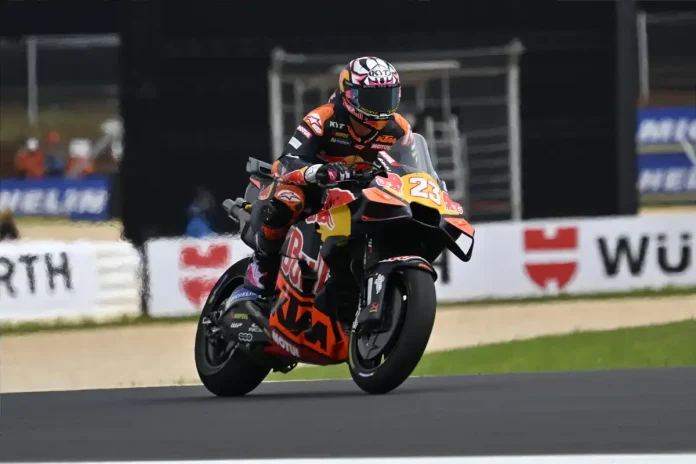
Enea Bastianini’s weekend at the Goiânia circuit could have been a triumphant return for both him and the Tech3 team after a rocky start to the season in Thailand. Instead, it spiraled into a nightmare for the 28-year-old racer. Struggling to find his rhythm on the RC16, Bastianini managed to scrape together just a single point in the Grand Prix, but that was far from his only challenge. The asphalt’s deterioration on the track forced a significant cut in the race laps, reducing them from 31 to just 23.
Reflecting on the situation, Bastianini expressed his concerns about the conditions, revealing, “During the warm-up lap, I took a lot of stones to the face and body, and I thought: ‘Wow, racing in these conditions will be tough.’ In the end, it was complicated, but less than I expected.” He candidly admitted that he was bracing himself for a potential race withdrawal after a painful encounter with a stone that hit him hard on the shoulder. “It was really painful at first, but it’s normal; it happened in the past when the asphalt was new. As I said before, the track probably wasn’t ready to host the GP, but we managed to get through it despite some difficulties.”
The impact of these racing conditions on performance is undeniable. “You don’t think about it, but you feel the pain,” Bastianini stated, highlighting the toll the situation took on him physically. “I’m covered in bruises. You get hit by a stone, but you have to keep going even if it hurts and try to stay focused. I was struck by a big stone, and now I’m in a lot of pain.”
However, Bastianini was particularly scathing about the decision made by the race direction to shorten the Grand Prix. The announcement came mere minutes before the race, leaving teams and riders scrambling. “It was a mess because it’s a big mistake in a World Championship. My team received the message at the last minute, and we didn’t have time to change the rear tire, but the other riders ahead had already done it,” he criticized. “The right choice would have been to wait five minutes so all riders were clear about the situation. I’ve seen many issues like this throughout the weekend. We talked about it, but nothing changed.”
During his analysis, the KTM rider also touched on what hindered his performance this weekend. “The track was new for everyone, and we thought it would be an advantage for us since we usually struggle a bit, but in the end, we faced more challenges than in other races. The layout is really fast: sectors two and three are a bit slower, but with a lot of acceleration, and we struggled specifically with that.” Saturday proved particularly difficult, as wet conditions on Friday meant they hadn’t had a chance to ride in dry conditions. “Every Friday I get on the bike, I don’t have the confidence to push. I have to reset every time and try to build something for the weekend. We definitely missed something,” he lamented. “It’s clear, looking at the other KTM riders, that they missed something too. Pedro wasn’t fast today because my pace was very close to his, but it’s extremely tough starting from the back; you can’t fight for a good position.”
Bastianini’s candid reflections underscore the myriad challenges athletes face in high-pressure environments, and his criticisms raise important questions about race management and rider safety in MotoGP.