


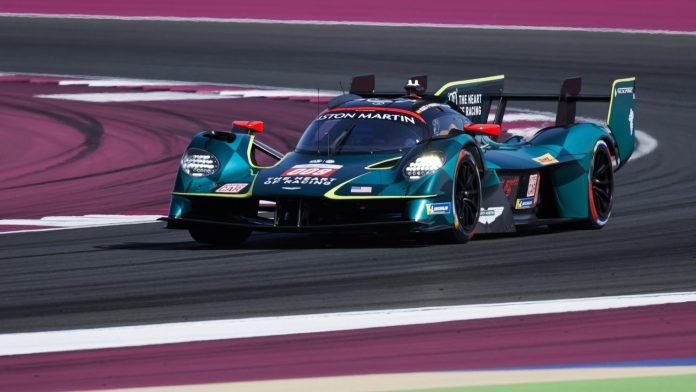
Aston Martin’s Valkyrie hypercar program is at a pivotal juncture, navigating the intricate labyrinth of endurance racing where the most daunting challenges have been addressed, yet the quest for unmatched performance hinges on the faintest advantages. As the team reflects on their journey through 2025, the progress made is both substantial and promising, igniting enthusiasm for what lies ahead.
The standout achievement of the Valkyrie this past season was undoubtedly clinching an impressive second place at the prestigious Petit Le Mans, marking a significant milestone in the IMSA season finale. In the World Endurance Championship (WEC), the Valkyrie showcased its capabilities with a commendable fifth place finish at Fuji and a seventh at Bahrain, although the latter result was tinged with disappointment. Harry Tincknell revealed, “At times we had some really strong pace and we were flying. Unfortunately, the second Virtual Safety Car came out just a lap after we’d pitted and that put us a lap down, which really hurt our race.”
In a thrilling twist, the Valkyrie led a WEC race for the first time at Sakhir, maintaining the front position for an exhilarating 12 laps. Alex Riberas even clocked the third-fastest race lap, just 0.628 seconds shy of the best. Ian James, the THOR team principal, reflected on the remarkable turnaround from the season’s start, stating, “In Qatar, we were a couple of seconds off the pace and people were writing us off. So to come to a place here where we’re genuinely competing for pole position and the podium shows what a good job everyone’s done.”
While Aston Martin ended up at the bottom of the WEC manufacturers’ standings with 24 points, this statistic must be viewed through a broader lens. As the sole newcomer in the Hypercar class, the team faced a particularly harsh Balance of Performance (BoP) landscape, relying initially on data from established competitors due to the lack of historical benchmarks. The breakthrough came in July during the Sao Paulo race, where the Valkyrie’s performance would finally be assessed on its own terms.
Adam Carter, the Head of Endurance Motorsport, elaborated on the complexities of their journey: “The programme goes from nothing, to building a team, to building a car, then testing, while at the same time preparing everything needed to go racing… Everything begins to come together.” This context paints a more optimistic picture of the inaugural season, especially against a backdrop of competing with teams that have decades of experience at the pinnacle of motorsport.
Despite only one Valkyrie finishing the grueling Qatar 1812km race, both vehicles completed the legendary Le Mans 24 Hours, albeit several laps behind the Ferrari 499P. This achievement still serves as a solid foundation for future endeavors, with Carter noting, “Reliability has been a very strong point, because it gives us the opportunity to go and develop things.” The Valkyrie has shown marked improvements in terms of mid-corner speed and overall performance, but challenges remain. Carter acknowledged, “The weaker point is degradation… It’s not bad, but to be right up there with the leading teams, we’ve got some work to do.”
Looking ahead to 2026, the strategy appears to be one of continuity rather than drastic change. Aston Martin THOR is set to field two Valkyries in the WEC and one in IMSA, with an experienced lineup that includes Roman De Angelis, Ross Gunn, Alex Riberas, and Marco Sorensen. Ian James praised the drivers for their performance, stating, “The drivers as a group delivered over and above what we asked from them,” emphasizing the depth of knowledge and cohesion built within the team.
While no major hardware upgrades are in the pipeline, the team is keenly focused on unlocking further performance within the existing framework, particularly through software enhancements. By the end of 2025, the Valkyrie emerged as the lightest and most powerful car on the grid, a position that comes with its own set of expectations. Carter remains cautiously optimistic, saying, “I’m very pleased with where we are right now. But today doesn’t guarantee tomorrow.”
The stakes are higher as the team aims to convert potential into consistent performance. Aston Martin’s Valkyrie is no longer on trial in the Hypercar division; the real challenge now is to transform its promise into tangible results on the track. Addressing issues of tyre degradation and maintaining pace throughout race stints will be crucial as they strive for regular podium finishes—and ultimately, a shot at victory. The path ahead is fraught with challenges, but with determination and strategic focus, the Valkyrie could soon redefine its legacy in the world of endurance racing.