


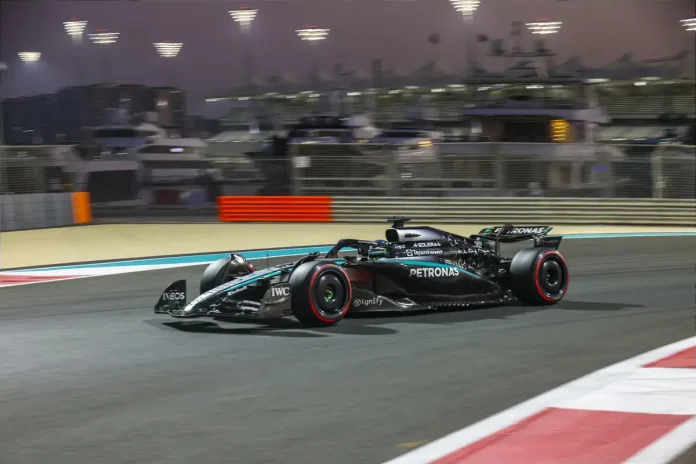
Mercedes boss Toto Wolff has opened up about the turbulent journey his team faced during the challenging ground-effect era of Formula 1, revealing the stark contrast to their earlier dominance in the hybrid age. After a stunning run from 2014 to 2021, where they clinched every Constructors’ Championship, expectations soared among fans and pundits alike. The Silver Arrows were anticipated to continue their reign, but the introduction of ground-effect technology posed unforeseen challenges that left the once-mighty team struggling to keep pace.
During this tumultuous period, Mercedes managed to secure only seven victories, a stark deviation from their previous success. Wolff acknowledged the team’s competitive spirit, stating that while their cars occasionally showed flashes of brilliance, those moments came far too infrequently for a team of their caliber. As they gear up for a fresh start with the introduction of a radical new rulebook next year, the specter of disappointment looms over their recent performances.
Reflecting on their time without a championship, Wolff noted that although they didn’t achieve the ultimate success, their consistent placements—P2, P3, P4, and another P2—shouldn’t be dismissed outright. “We failed to win a World Championship. But it was a P2, P3, P4, P2. That is not a complete failure,” he explained to the media, including Motorsport Week. However, he quickly tempered that optimism by admitting the team’s inability to compete with a rival that consistently outperformed them throughout those years.
The crux of Mercedes’ struggles can be traced back to their initial approach in adapting to the ground-effect changes. Wolff expressed regret over their strategy, admitting, “We got off to a wrong start at the beginning. We tried to solve problem by problem. Whilst peeling off and sorting out those problems, new problems occurred. And we were never able to correlate, understand.” This misstep set the stage for a series of false dawns that ultimately hindered their championship aspirations.
In stark contrast, Red Bull emerged as the dominant force in the ground-effect era, capturing half of the Constructors’ titles and nearly all the Drivers’ titles during this time. Meanwhile, McLaren made a significant resurgence, clinching their first Constructors’ title since 1998 in the latter half of 2024 and successfully defending it in 2025 with driver Lando Norris at the helm. Wolff conceded that while Mercedes generated many innovative ideas, none provided the crucial edge needed to reclaim their former glory.
“We had false dawns and lots of kind of theories,” Wolff admitted. “But never one that would give us an edge to fight for a World Championship. And our competitors have just done a better job.” He pointed out the stark contrast in performance between Mercedes and teams like McLaren and Red Bull, who exhibited a remarkable ability to identify their shortcomings and make drastic improvements. “What has happened since the summer is clearly an understanding, or at least an exemplary of how you can find out what is not working and turning a campaign around massively. We have actually never been able to do that in four years,” he lamented.
As the Formula 1 world looks ahead to the new regulatory landscape, the pressure mounts on Mercedes to reclaim their position at the pinnacle of motorsport. The lessons learned during the ground-effect era will undoubtedly shape their strategies moving forward, as they aim to revive their legacy and silence the critics who now question their dominance in the sport.