


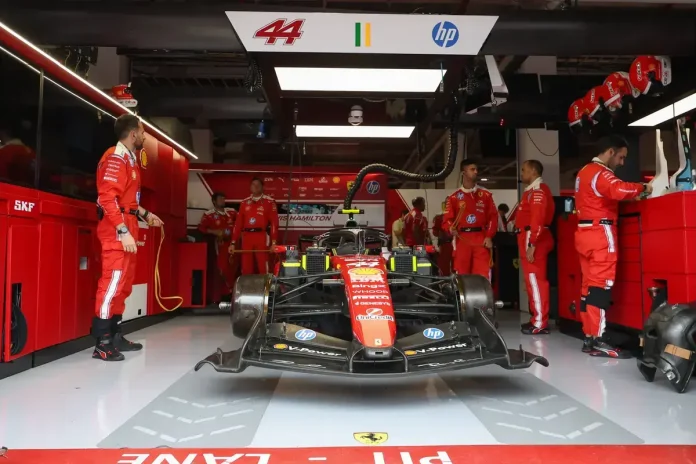
Lewis Hamilton has thrown down a gauntlet to Ferrari, highlighting a critical weakness in the SF-26’s front wing design that could be holding the team back in Formula 1. Speaking ahead of the Miami Grand Prix, Hamilton pointed out that while rivals like McLaren, Red Bull, and Mercedes have made significant strides through front wing upgrades, Ferrari’s approach appears stuck in the past—a potential blind spot that might explain their struggles with drag and overall pace.
Hamilton’s observations zero in on a core aerodynamic battleground. “They—Mercedes, McLaren, and Red Bull—are doing something different with their front wing compared to us,” he said. “So we need to look into that to see whether or not there’s something we can improve on.” When pressed whether this was about differing modes on straights and corners or a fundamental concept, Hamilton confirmed it was a conceptual difference. “If you just look at everyone else’s wing and look at us, you’ll see it looks different,” he added. “So, I don’t know if that’s necessarily the whole thing, but I wonder what that’s doing, because the others seem to have it and they’ve improved…”
A detailed comparison of the front wings from Ferrari, Red Bull, Mercedes, and McLaren reveals the nuances Hamilton alludes to. The front wing is the first aerodynamic surface to interact with airflow, setting the tone for the entire car’s performance. Small differences in its profile and integration can cascade into big gains or losses down the track.
Red Bull’s front wing stands out with intricate integration between the main plane and endplate, featuring small raised profile sections that fine-tune airflow before it hits the floor’s leading edge. Mercedes and McLaren share a similar design philosophy, with a higher wing profile further outboard that reduces sensitivity to mid-corner body roll. This helps maintain consistent downforce through dynamic conditions.
Ferrari, by contrast, presents a simpler, less integrated front wing profile. The leading edge of its endplate sits noticeably forward compared to the wing’s leading edge, creating a gap that disrupts airflow. Its wing height is lower than Mercedes and McLaren, and the lack of a critical outer horizontal vane—commonly called a diveplane—marks a clear divergence.
This diveplane, present on Red Bull, Mercedes, and McLaren cars but absent on Ferrari’s, plays a pivotal role in managing the turbulent air around the front tires. As the tires carve through the air, the vane guides airflow either inside, outside, or over the top of the tire, balancing pressure zones to optimize downstream aerodynamics. Without it, more air is pulled unpredictably around the inside of the tire, leading to inefficient flow and increased drag.
Hamilton’s suggestion that the SF-26 suffers from excessive drag aligns with this aerodynamic shortfall. Ferrari’s front wing design could be causing compromised airflow management, impacting the entire car’s performance envelope. While the front wing alone won’t transform the car overnight, its relative simplicity and missing features indicate untapped potential.
The smallest gap between the flap assembly and endplate on Ferrari’s wing is also less integrated than on McLaren, which employs a more aggressive geometry to pull more airflow under the wing at higher flap angles. These details hint at Ferrari’s wing being more sensitive to mid-corner roll, potentially making the car’s handling less consistent during dynamic maneuvers.
In sum, Hamilton has exposed a subtle but significant front wing deficiency that Ferrari must address if it hopes to close the gap to the front runners. Red Bull’s complex flow management, Mercedes and McLaren’s stable profiles, and Ferrari’s comparatively rudimentary setup show the Italian team has room to evolve its aero package.
Ultimately, Formula 1 performance hinges on the harmony of every component working together. Hamilton’s insight underscores that while Ferrari’s front wing is not the sole cause of their struggles, it is a crucial piece of the puzzle—one that could unlock meaningful gains if developed with the precision and innovation seen at their rivals.