


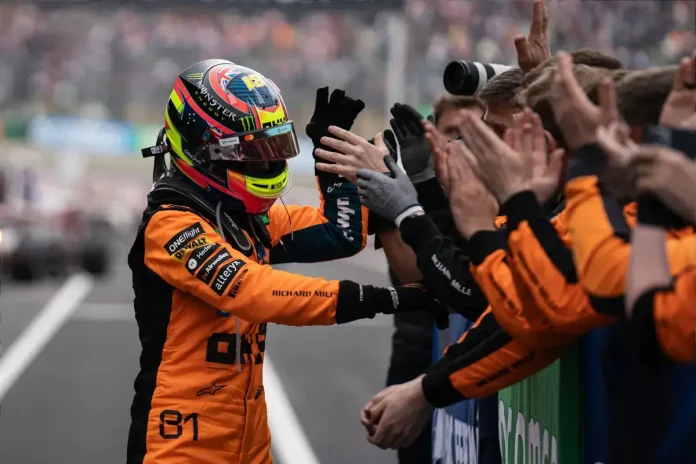
Oscar Piastri has sounded a striking warning to Formula 1 giants Mercedes, highlighting a glaring vulnerability that could shake up the championship battle in 2026. Despite Mercedes’ dominance in qualifying—locking out the front row at every race so far, including the Chinese GP Sprint—their consistent slow starts have opened the door for rivals McLaren and Ferrari to challenge their supremacy in the early laps.
At the Australian Grand Prix, Charles Leclerc capitalized on Mercedes’ sluggish getaway to seize the lead. In China, Lewis Hamilton showcased his racecraft by overtaking at the start, and at Suzuka, Piastri himself made a bold move past Kimi Antonelli and George Russell, briefly leading the pack. Yet, Mercedes’ superior race pace and strategic savvy have allowed them to claw back those lost positions and ultimately secure victories at every event, with Antonelli’s Japan win aided by a crucial safety car intervention shortly after Piastri and Russell had pitted.
Piastri offers a candid assessment of Mercedes’ advantage, dismissing any notion of “magic” behind their speed. Instead, he points to Mercedes’ higher downforce levels and more efficient power unit usage as the key factors propelling their dominance. “There is nothing magical about anything; they just have more downforce, are using the power unit better than us at the moment, and it is as simple as that,” Piastri explained. He also admitted that when actually behind the wheel, the Mercedes car “disappears pretty quickly,” underscoring the challenge McLaren faces.
Data analysis reveals McLaren is losing ground in multiple areas rather than suffering from a single glaring weakness. “There is not really one area where we’re weak or where we are strong; it is just across the board, so I think finding more downforce is the main opportunity,” Piastri said. This points to a fundamental development race McLaren must win if they are to consistently challenge Mercedes on pace and maintain better race starts.
Ferrari’s performance adds another layer of intrigue to the championship fight. Piastri noted Ferrari’s strength in cornering contrasted with possible drag or power unit deficiencies, making them a unique threat on the grid. The Chinese Grand Prix showcased Ferrari’s ability to tussle with Mercedes at the start, proving the Scuderia’s pace and tenacity could upset the established order. “The Ferrari is interesting as well because it almost looks like they are better in the corners, but may be worse on the power unit or with drag,” Piastri said. “China was interesting in the way they’ve been able to battle Mercedes. They’ve got a clear advantage on everybody, but the way that Ferrari was able to battle and contend with them at the start of races, especially, is quite interesting to see, so there is inspiration in more than just one place.”
This emerging trend of Mercedes faltering out of the gates injects a fresh narrative into the 2026 F1 season. If McLaren and Ferrari can sharpen their starts and develop their cars’ overall performance, they could exploit the cracks in Mercedes’ armor. The championship battle might hinge not just on outright speed but on mastering the critical first few corners—a phase where Mercedes has shown vulnerability. Piastri’s insights shine a light on the evolving dynamics of the grid and promise a thrilling season ahead as teams scramble to seize every advantage.