


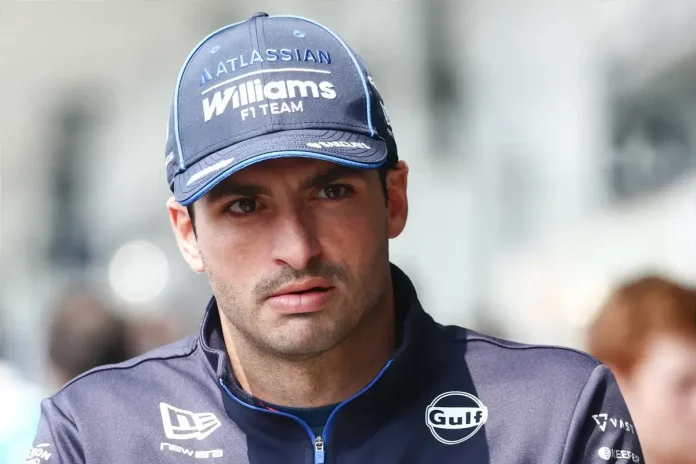
Williams’ 2026 Formula 1 campaign has stumbled out of the gate, revealing a critical and persistent flaw that threatens to derail their ambitions. After a respectable fifth-place finish in the Constructors’ Championship last year, the team now finds itself struggling with a glaring issue that has plagued the car since the regulations changed: a severe lack of inside-front tyre grip. This problem, described vividly by drivers Carlos Sainz and Alex Albon, is more than just a technical hiccup—it’s a fundamental weakness that has forced Williams into a frustrating cycle of trial and error at the start of the season.
Sainz and Albon have been brutally honest about the challenge. Albon pinpointed the problem during the Japanese Grand Prix at Suzuka, explaining that the inside-front tyre’s contact patch with the track surface diminishes significantly in certain corners, causing what he described as a ‘three-wheeling’ sensation. “Lack of inside front grip has been an issue on our car since I’ve been in the car, so that’s nothing new,” Albon admitted. He traced the problem’s roots back five years, recalling how corners like Bahrain’s Turn 9 and Turn 10 double left-hander highlighted this weakness. The downgrade in downforce this year, due to new regulations, has only magnified these issues, forcing the team to dedicate precious FP1 sessions to experimenting with solutions. Albon’s stark observation that the tyre is “not really in the air” but simply doesn’t have the same contact patch as the other three tyres paints a clear picture of a car struggling for balance and grip.
Sainz corroborated this assessment, revealing that the team had managed to work around the problem during 2025, but the switch to new regulations in 2026 brought the issue back with a vengeance. “It seemed like the Williams had this vehicle dynamic characteristic that, let’s say, surprised me from the first lap I did in Abu Dhabi,” Sainz said. He described how he and Albon have provided “very clear directions” to the team about when and how the problem manifests, emphasizing the collaborative effort to find a fix. Despite their efforts, the lack of front-end grip remains a thorn in Williams’ side, one that threatens to undermine their competitiveness if not resolved swiftly.
The timing couldn’t be more critical. Formula 1 is currently in an unexpected April hiatus following the cancellation of the Bahrain and Saudi Arabian Grands Prix. With no mandated factory shutdown during this break, teams like Williams are racing against the clock to analyze early-season data and fast-track development. Weight reduction has been identified as a primary target for the FW48, alongside efforts to regain lost downforce. Sainz expressed cautious optimism about the team’s upgrade plans for Miami, warning that improvement is a relative game. “You can bring a big step forward, then if the others bring a big step then you haven’t moved forward – you’re still three tenths behind the midfield,” he said bluntly. The battle isn’t just about fixing problems—it’s about outpacing rivals in a fiercely competitive midfield pack.
This admission underscores the stark reality facing Williams: the team’s fate this season hinges on their ability to not only solve the inside-front tyre grip issue but to do so ahead of competitors who are also relentlessly evolving. The FW48 is far from the sleek, balanced machine Williams hoped for, and the drivers’ candid feedback has exposed vulnerabilities that demand urgent and effective engineering responses. With the season’s momentum halted unexpectedly and crucial races canceled, every day of development counts more than ever.
Williams’ predicament is a stark reminder that in Formula 1, past success offers no guarantees. The sport’s brutal technical evolution can unearth hidden flaws, forcing teams to adapt or fall behind. For Williams, the road ahead is steep, but the team’s willingness to confront these issues head-on and the drivers’ unfiltered insights could be the catalyst for a comeback. The upcoming upgrades will be scrutinized closely, as fans and pundits alike watch to see if Williams can turn their inside-front grip nightmare into a stepping stone rather than a stumbling block in their 2026 campaign.