


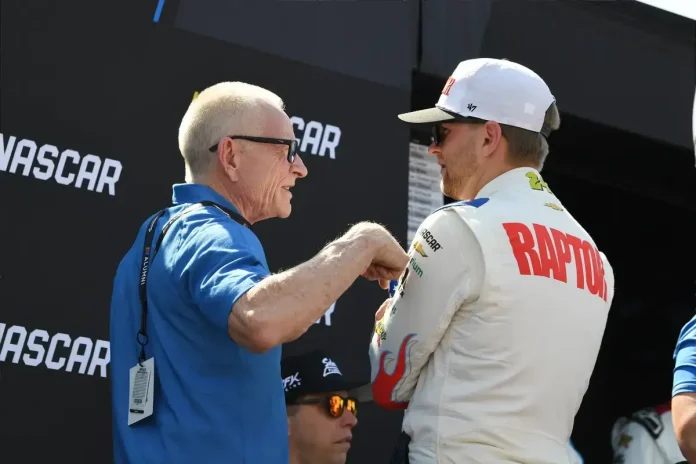
Mark Martin, a NASCAR legend and Hall of Famer, has unleashed a stunning critique against Ford, accusing the iconic automaker of abandoning its deep-rooted commitment to stock car racing. After more than 20 years closely linked with Ford, Martin’s candid remarks are sending shockwaves through the NASCAR community, hinting at a seismic shift that could redefine the future of Ford’s involvement in the sport.
In a no-holds-barred interview on the Door Bumper Clear podcast, the 67-year-old veteran didn’t hold back his frustration. Martin bluntly accused Ford of stinginess, suggesting the company’s priorities have dramatically shifted away from NASCAR and toward the glitzy world of Formula One. “Ford just doesn’t invest, and right now it looks like they’re even less. They’re probably shifting their money toward F1. I don’t know,” Martin declared. He added, “I felt like that the reason we were less favored, we being Fords were less favored than other manufacturers, is because they participated less in, you know, outside of they spent less money outside of what they did for their teams.”
This is no idle speculation; the numbers back up Martin’s grim assessment. Ford’s presence in NASCAR is shrinking at an alarming rate. By 2026, only a handful of teams will still carry Ford’s banner, marking a stark contrast to the brand’s once-dominant footprint. The NASCAR O’Reilly Auto Parts Series reveals the most dramatic decline, with Ford represented by just a single team. For a company known for its legendary volume and visibility on the track, this drop signals a devastating retreat in the face of rivals like Chevrolet.
At the Cup Series level, Ford’s influence now feels more concentrated than expansive. Powerhouses such as Tim Penske’s Team Penske and RFK Racing remain Ford’s bastions, but beyond these stalwarts, Ford’s pipeline of competitive teams is dangerously thin. The Truck Series paints a similar picture, with Ford entries noticeably limited compared to the competition. This narrowing presence could have severe consequences, especially as depth in driver development and team strength becomes more crucial than ever.
What’s driving this retreat? The answer lies in Ford’s pivot to the global racing stage. The automaker’s headline-grabbing partnership with Red Bull Racing for the 2026 Formula One season represents a massive strategic gamble. Developing engines under the new F1 regulations demands vast resources and engineering talent—resources that Ford appears to be diverting away from its NASCAR programs. This redirection of focus and funding threatens to relegate NASCAR to a secondary priority. Combine that with Ford’s traditionally secretive stance on sharing technical data with teams, and you have a manufacturer leaning heavily on loyalty rather than expansion, even as competitors aggressively grow their footprint.
Martin’s concerns are underscored by broader industry challenges. The U.S. auto sector faced turbulence in late 2025, with rising costs and tariffs hammering consumer demand. Even giants like General Motors suffered sales declines, and Ford was likely not immune. When budgets tighten, motorsport programs often feel the squeeze first, forcing difficult choices that can leave racing efforts underfunded and under-resourced—exactly what Martin fears is happening at Ford.
Beyond the corporate strategies and financial pressures, Martin also shared his insights into the grueling reality of NASCAR competition today. He emphasized that teams work relentlessly week after week, but success is far from guaranteed or immediate. “Competition ebbs and flows, whether it’s a change in the, a little bit, a little bitty change in body shape on the front or the back or something like that,” Martin explained. “Or, or if it’s just competition, it’s always increasing.”
His comments arrive amidst a turbulent start to the 2026 NASCAR season, where Hendrick Motorsports has struggled to find form. While Toyota and Ford have surged ahead early on, Chevrolet, despite unveiling a new body design, seems to be lagging behind. Martin highlighted the brutal nature of the sport, where teams can pour in massive effort without instant results. Yet, he also acknowledged the importance of breakthroughs, like Chase Elliott’s recent win for Hendrick, which can suddenly propel a team forward after long periods of stagnation.
“Sometimes they get better faster, and sometimes they get stuck, and they work hard as they can, but they don’t get anywhere for a while, and they fall behind,” Martin noted. “Not because they’re not working, just because that’s how sometimes what you work on doesn’t bear fruit. And then other times it does, you know, bear really sweet fruit.”
This relentless cycle of trial, error, and eventual triumph shapes the fiercely competitive landscape of NASCAR, where every tweak and adjustment can mean the difference between victory and mediocrity.
Mark Martin’s outspoken criticism of Ford is more than just a veteran’s lament; it’s a warning signal flashing bright for NASCAR fans and insiders alike. If Ford continues to prioritize its shiny new F1 venture over its historic NASCAR roots, the ripple effects could reshape the sport’s competitive balance for years to come. The question now is whether Ford will heed this wake-up call or continue down a path that risks alienating the very fanbase and racing culture that helped build its legendary status.