


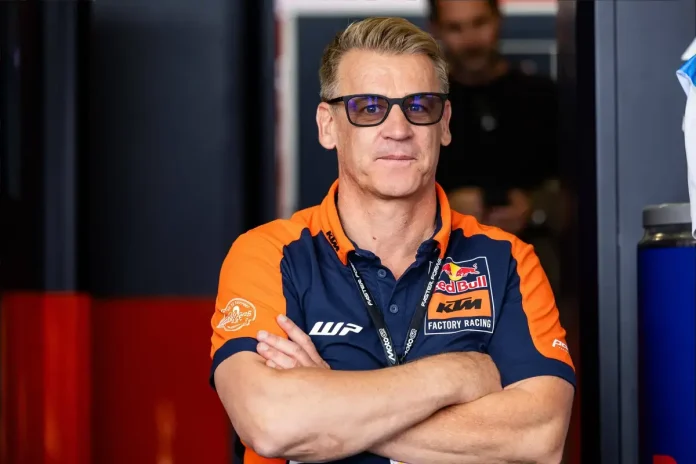
In a stunning turnaround, KTM has emerged from the shadows of insolvency to reclaim its place in the highly competitive world of MotoGP. Pit Beirer, the driving force behind KTM Motorsport, offers a candid reflection on a year that tested the very limits of the company’s resilience. Just one year ago, the future of KTM in MotoGP was hanging by a thread, with bankruptcy looming and a desperate scramble for survival. Today, however, Beirer reveals that the storm has passed, and with the full backing of new Indian owners Bajaj Auto, KTM’s MotoGP ambitions are not just alive but thriving.
“Last year, I had a terrible Christmas,” Beirer confesses, his voice tinged with the weight of the past. “I couldn’t sleep at night and spent every day at the company to support our riders at the start of the year.” This stark admission underscores the profound internal pressures that engulfed KTM as it navigated through one of the darkest chapters in its history. What was once a dream of championship glory had devolved into a financial quagmire.
Fast forward to the present, and the landscape has drastically shifted. Pierer Mobility AG has transitioned to Bajaj Mobility AG, now under the majority control of Bajaj Auto. “This year, we benefited from a stable budget and rigorous planning,” Beirer states with newfound optimism. The figures tell a compelling story of recovery: for 2025, KTM recorded a revenue of €1,009 million, a stark 46% drop from previous highs, yet the net debt has been slashed to €798 million — nearly halved — and equity has rebounded to a positive €385 million.
However, this comeback comes at a steep cost. The company announced the painful loss of 500 jobs and the closure of its bicycle division, while bike sales plummeted. Yet, amidst these challenges, a flicker of hope has emerged. In the second half of 2025, KTM reported a remarkable resurgence, selling 80,464 motorcycles — a staggering 60% increase compared to the first half. With sales driven by Bajaj Auto’s distribution, total motorcycle sales soared to 209,704 units.
For Beirer, the lifeline has a name: Bajaj. “This was undoubtedly the most challenging period in the company’s history. But thanks to Bajaj, we are still here today. Their unwavering commitment saved the company and allowed us to rebuild.” He emphasizes the critical support from Bajaj, stating, “Without their commitment, I wouldn’t have even been allowed to discuss the new five-year contract with Dorna. Everything you see from me is, of course, achieved with Bajaj’s full support.”
The transformation at KTM is profound. The ownership structure has changed dramatically, allowing direct accountability to the new owners. Their logo is now prominently displayed in MotoGP, marking a significant shift in the team’s identity and strategy. Beirer acknowledges the harsh reality of MotoGP, noting, “I have probably felt more intensely than any of the five manufacturers just how quickly a MotoGP project can become a financial black hole.”
The pressing question remains: can a MotoGP project evolve into a sustainable business model? With Liberty Media’s acquisition of Dorna Sports, there is a glimmer of hope for growth akin to what Formula 1 has experienced. Yet, Beirer is candid about the present: “Currently, the only major investors in this sport — those actually injecting real money — are the five manufacturers.”
KTM is not closing the door on potential investors. “If there are ways to reduce losses for manufacturers and create a more viable business model, we are open to discussion.” In a recent boost to morale, KTM celebrated another triumph at the Dakar Rally, reinforcing its standing in motorsport. “Our recent successes in motorcycle sports give us an additional boost and significantly contribute to our sales increase,” asserts CEO Gottfried Neumeister.
Two new partnerships have also been forged, with Motorex for lubricants and Würth for tools, signaling a renewed sense of confidence. KTM no longer speaks of mere survival; instead, they are focused on “stable and promising growth.” Yet, the tumultuous events of 2025 have left a lasting scar. While MotoGP remains a strategic pillar for KTM, it is clear that the days of taking it for granted are over.
Beirer does not shy away from the harsh realities. “We all participated in the tough times… but I am convinced that Gottfried is truly the right person to lead us out of this situation.” The takeaway is clear: KTM is firmly entrenched in MotoGP, but now, with a calculator on the table, every move will be calculated with precision and intent.