


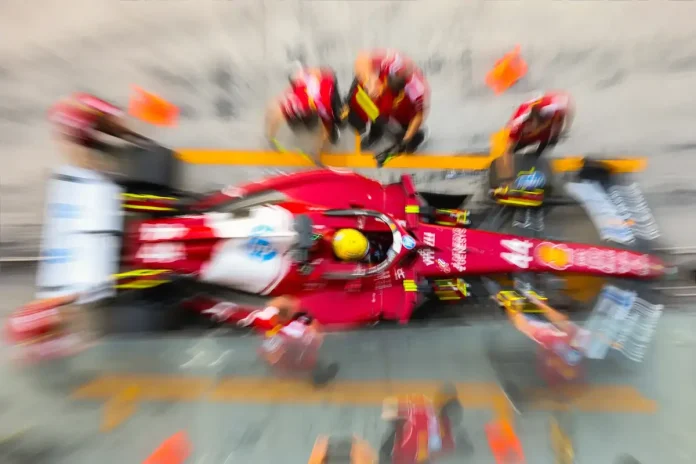
Hidden away within the bustling confines of Ferrari’s garage lies a cutting-edge laboratory that fuses the worlds of chemistry and engineering, playing a pivotal role in the high-octane realm of Formula 1 racing. This state-of-the-art facility, operated by a dedicated team of chemists from Shell, is the heartbeat of Ferrari’s on-track operations, ensuring that every component of the car is fine-tuned for peak performance week after week.
As the wheels of the racing circuit turn, Shell’s mobile chemistry lab accompanies Ferrari on its global journey, equipped with a suite of high-precision instruments and software that hums with the promise of scientific discovery. Stepping inside this lab, one is immediately enveloped in a realm where adrenaline and analytical prowess intersect. “This laboratory goes around the world,” shares Shell trackside analyst Lauren Singer, a passionate chemist who has dedicated her career to this thrilling environment. “The lab itself doesn’t change, but the minute you step outside these doors, everything is different. The cities, the countries you go to, are so different.”
Singer’s path to this unique position was a blend of fate and fervor. With a childhood fascination for chemistry, she pursued energy-related research at university, always seeking to uncover the ‘why’ behind the world around her. “Chemistry answers those questions,” she explains, emphasizing how the science not only satisfies curiosity but also acts as a guiding force in the fast-paced world of motorsport. “In motorsport and especially in this role, you naturally have an element of problem solving… finding why has the problem happened and then what is the solution we can find here on track,” she elaborates, highlighting the high-pressure nature of her work.
The race weekend begins long before the engines roar to life. As soon as Tuesday arrives, the lab is set up within the Ferrari garage, transforming an empty space into a buzzing hive of activity. The analysts meticulously prepare for the influx of fuel and lubricant samples that are critical for maintaining compliance and performance. “We test the fuel every time it changes location,” Singer details, as she demonstrates the advanced equipment designed to meticulously analyze each sample. “The idea behind these machines is [that] they take a small amount of the fuel, they evaporate it, and they basically separate individual components.”
This rigorous testing ensures that the fuel delivered to the track remains compliant with FIA regulations, as any contamination could jeopardize the entire operation. The precision of their testing is akin to fingerprint analysis, as they compare the chemical profiles of fuel transported from places like Hamburg to the circuits in Austin or Singapore. “That’s really important, because the fuel which left Germany is compliant,” Singer notes, reinforcing the critical nature of their work.
However, it’s not just fuel that occupies the analysts’ attention. The true essence of their laboratory work lies in the comprehensive testing of lubricants. Following each session on the track, fresh engine oil samples are sent to Shell for analysis, providing insights into the engine’s internal workings without ever opening it up. “We do about 150 of these tests each weekend,” Singer reveals, emphasizing the importance of detecting minute traces of metal content that might indicate issues within the engine. “It’s almost like a blood sample for the car,” she explains, likening the oil analysis to a vital sign check, crucial for diagnosing potential problems before they escalate.
The stakes are incredibly high during race weekends, particularly in sprint formats where time is of the essence. With mere minutes between sessions, the speed of Shell’s testing—taking just two minutes to provide critical data—becomes invaluable. “We can get that data to Ferrari really quickly so their telemetry and our chemistry work together,” Singer states, illustrating the seamless integration of science and strategy that defines modern Formula 1 racing.
Beyond the technical challenges, the emotional landscape of the job is equally demanding. “You have to be positive. You have to love people. I think generally you have to be very resilient,” Singer emphasizes, recognizing the intensity of their work environment and the camaraderie that forms among the team. The travel schedule can be grueling, with logistics that sometimes stretch the limits of patience and endurance, especially in unique locations like Monaco, where the lab is stationed two kilometers away from the paddock.
Yet, amidst the chaos, there is an undeniable sense of purpose. The data gathered from this compact laboratory extends far beyond the realm of racing, influencing the development of fuels and lubricants that will shape the future of both motorsports and everyday vehicles. For Singer, being part of this journey—contributing to a legacy rooted in science and innovation—is immensely gratifying. “It really is an honor,” she reflects. “I do actually feel a little bit to be part of this team and part of this partnership, especially as someone who loves chemistry.”
The memories forged in the heat of competition, from thrilling victories to the daily grind of preparation, become cherished moments that define her experience. “Real highlights for me are when we have a good result; the joy and happiness of the team, the atmosphere and the buzz is one of the best experiences,” she recalls, capturing the essence of teamwork that defines life in the fast lane.
In a sport where every millisecond counts, excellence is not just found on the track; it thrives in the hidden corners of Ferrari’s garage, where a dedicated chemist races against time to deliver the insights that could make all the difference in the pursuit of glory.