


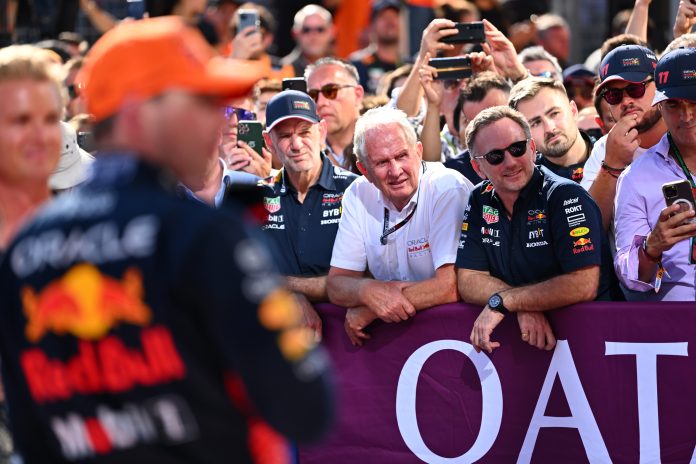
In a fiery revelation that shakes the very foundation of Red Bull Racing, Helmut Marko has unleashed a scathing critique of Christian Horner, attributing the catastrophic failures of the 2025 season directly to his former colleague’s mismanagement. Marko’s explosive comments come on the heels of his departure from the team and reveal a tumultuous power struggle that has been brewing in the Milton Keynes ranks for the past two years.
The turmoil within Red Bull is said to have ignited in early 2024, triggered by scandalous allegations of inappropriate behavior involving Horner and a staff member. Although Horner was cleared of any wrongdoing, the internal atmosphere soured, revealing a stark division between the Austrian faction and the British core of the team. This rift intensified amid perceptions of the UK’s media influence, ultimately leading to the exit of key figures, including the renowned designer Adrian Newey.
While the team appeared outwardly stable at the dawn of 2025, Horner’s unexpected ousting during the summer marked a critical turning point. This upheaval coincided with a significant dip in performance, which was only reversed after the introduction of a new development package during the Monza race. This resurgence allowed Max Verstappen to enter the final race with a shot at clinching his fifth consecutive title, but he ultimately fell short—a failure Marko attributes to the late actions of the leadership.
Marko recalls the inception of Red Bull Racing in 2005, co-founding the team alongside Dietrich Mateschitz, with Horner appointed as team principal but decision-making power firmly in Austrian hands. According to Marko, Horner seized the opportunity presented by Mateschitz’s declining health and subsequent passing to bolster his position with Chalerm Yoovidhya, Red Bull’s co-owner, in a bid to consolidate control over the organization.
In a stunning twist, Marko also exposes a web of deceit and political maneuvering within Red Bull, alleging smear campaigns aimed at discrediting him. He vehemently denies accusations regarding Sergio Pérez and claims about delays in engine development, asserting these fabrications were designed to undermine his credibility. He expresses that it was only Verstappen’s intervention that prevented his suspension, and as time passed, Yoovidhya began to see through the lies.
“We had to act because the on-track performance was declining,” Marko stated emphatically. “Had we made changes sooner, we would have recovered faster, and Max Verstappen would have been the world champion this year. I am absolutely convinced of that. Together with Didi [Mateschitz], I founded Red Bull Racing in 2005. We appointed Horner as team principal, and I was there as a supervisor. Initially, the power was always in Austria; we were the ones making decisions.”
Marko reflects on Horner’s growing influence, noting, “Christian told me, ‘he won’t make it to the end of the year.’ From that moment, Christian began to cozy up to Chalerm Yoovidhya. The last few years with Horner were unpleasant. Dirty games were at play. Remember when they claimed I said Mexicans were less focused than the Dutch or Germans during Sergio Pérez’s management? That was fabricated, probably by them.”
He continues to address the false narrative surrounding the supposed delays in engine development, asserting, “I never said that, but Horner wanted to use it as a reason to suspend me. Thanks to Max’s support in Jeddah, that didn’t happen.”
As the dust settles on his departure, which was officially framed as his decision but is widely believed to be the result of internal dissatisfaction with his initiatives, Marko downplays the circumstances. “I don’t want to get into too many details, but I didn’t read that press release full of nonsense. Let’s just say a lot has changed within the team in a short time. You think you know people well, but in the end, you discover it’s not quite like that. I won’t say more.”
Marko’s revelations not only cast a shadow over Horner’s leadership but also raise critical questions about the future of Red Bull Racing and its ambitions in the fiercely competitive world of Formula 1. As the team navigates this storm, fans and analysts alike will be watching closely to see how these internal conflicts unfold and whether they can rebound from this tumultuous chapter.