


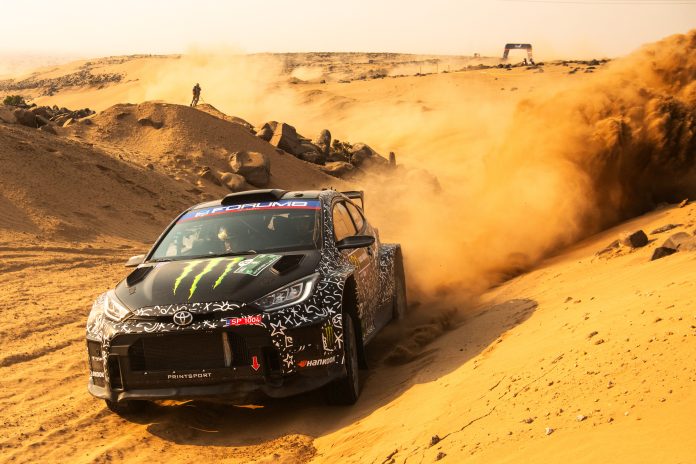
Oliver Solberg is gearing up for a monumental leap in his career as he prepares to debut as an official Toyota driver in the World Rally Championship’s top tier in 2026. This past weekend, the young Swedish sensation took to the stages of the Rallye Hivernal du Dévoluy, an event that served as a crucial training ground for him to sharpen his skills on asphalt behind the wheel of the formidable Toyota GR Yaris Rally1. This experience is not just an ordinary step; it’s a vital part of his preparation leading up to the prestigious Monte Carlo Rally.
After an exhilarating victory in Estonia last summer, where he first got the chance to pilot a Toyota Rally1 on gravel, Solberg faced a fresh and distinct challenge this time around: mastering the art of competitive driving on asphalt. He candidly acknowledged that the feeling is worlds apart, emphasizing that this surface demands a deeper trust in aerodynamics and allows for higher speeds in fast sections.
With no prior testing under his belt, Solberg jumped right into the rally with a base setup and made adjustments almost after every stage, using the various neutralizations to refine the car’s setup. During the event, he had the opportunity to measure his performance against Adrien Fourmaux, who competed in the same rally last year with a Rally1. Initially, the French driver set a quicker pace, but Solberg showcased his remarkable adaptability by overtaking Fourmaux on the second day, proving his potential to learn and improve rapidly.
Despite his progress, Solberg remains grounded, acknowledging that there is still a mountain to climb, particularly when it comes to pace notes and confidence in high-speed corners—areas where transitioning from a Rally2 to a Rally1 poses significant challenges. He will have another day of testing before the Monte Carlo Rally, scheduled for late January, ensuring he is as prepared as possible for the demanding conditions ahead.
Reflecting on his experience, Solberg shared his insights: “The feeling is different. On gravel, it feels more natural; you’re always limited by grip. You’re always sliding, so you can feel the aerodynamics better. Here, you have to learn the aerodynamics and trust in it. There’s a lot of grip, and in some fast corners, you think: ‘OK, I can go fast.’ So, it’s a bit different. I didn’t have a test, so I didn’t really know what to expect. You just have to feel it a bit and understand what you can do. Now I have an idea in my head of what I need, what I want. In some of these fast corners, I’m easing off or maybe braking a bit because I’m unsure. There’s a lot to learn about the notes and the speed. In a Rally2, I know exactly what the right speed is.”
As Solberg continues to fine-tune his skills and adapt to the demands of higher-tier rallying, the motorsport community eagerly anticipates his journey, which promises to be nothing short of thrilling.