


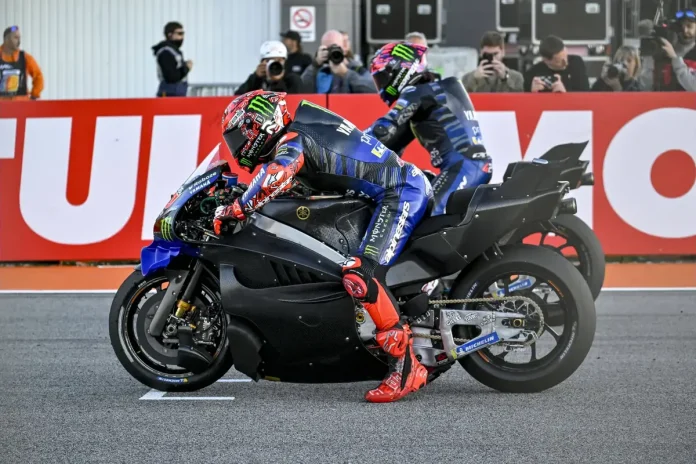
Yamaha is making waves in the MotoGP world with its radical shift from a long-standing inline-four engine to an ambitious V4 design, but the decision has ignited a storm of uncertainty. This bold move, the most significant by the manufacturer in the last two decades, aims to pull the brand out of a competitive rut against formidable rivals like Ducati, KTM, and Aprilia. However, the mixed signals emanating from within Yamaha have left fans and experts questioning the true state of the team’s future.
The unveiling of the YZR-M1 V4 during the 2025 San Marino Grand Prix was a historic moment, marking Yamaha’s first venture into V4 technology since the end of the two-stroke era in 2002. With Augusto Fernandez participating as a wildcard, the bike has since undergone extensive testing in Malaysia and Valencia, accumulating vital data that could steer its development. Central to this venture is Andrea Dovizioso, a veteran with 22 years of Grand Prix experience, who is playing a crucial role in refining the V4 through private tests and close collaboration with Yamaha’s engineers.
However, not all news is rosy. Reigning world champion Fabio Quartararo, initially seen as a driving force behind this overhaul, has voiced significant concerns following his first outings on the new machine. His frustration is palpable as he expresses disappointment over the bike’s performance, citing a lack of feedback and a power unit that fails to meet expectations. This stark contrast in perspectives has raised eyebrows, particularly for former MotoGP star Marco Melandri, who is now an astute observer of the paddock.
In a revealing interview, Melandri shared his skepticism regarding Quartararo’s ability to adapt to the new V4, stating, “I think it will not be easy for Fabio to replicate what he did with the inline-four.” He emphasizes the challenge of finding the right setup and balance, having been so accustomed to the previous engine configuration. With Yamaha’s other riders reportedly echoing Quartararo’s discontent, Melandri’s concerns deepen. “It seems that all the Yamaha riders are complaining about the new bike. I expected more from the engine on the track,” he remarked.
This situation leads to an intriguing question: Is Yamaha bluffing about the capabilities of its new V4? Melandri believes the dissatisfaction among the riders starkly contrasts with Dovizioso’s optimistic outlook. “I prefer to trust Andrea, as he is the one developing the bike and knows the situation perfectly,” he stated, pointing to the dual narratives unfolding within the team.
Adding to the complexity, former champion Jorge Lorenzo has indicated that Yamaha is “extremely satisfied” with the direction of the V4 project based on discussions with Dovizioso. Likewise, newcomer Toprak Razgatlioglu has expressed positive feelings about the bike’s performance, further complicating the narrative as Quartararo feels increasingly isolated in his criticism.
As Yamaha navigates these choppy waters, it faces a pivotal moment. The 2026 season looms large as a make-or-break scenario: will the V4 elevate Yamaha back to the pinnacle of MotoGP, or will it drive a wedge between the team and its star rider? With optimism from some and doubts from others, the situation remains precarious. Melandri’s insights serve as a reminder that beneath the surface of corporate communications, uncertainty reigns supreme. The MotoGP landscape is set for a dramatic evolution, and all eyes will be on Yamaha as it attempts to harness this new power while managing the delicate balance of team dynamics.