


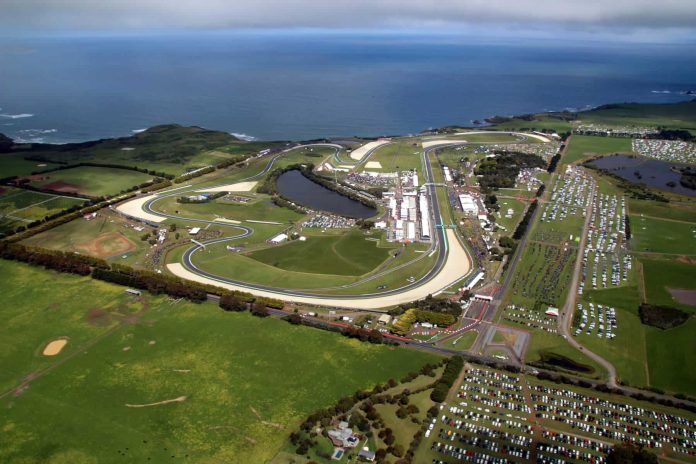
In a shocking turn of events, the future of Phillip Island, a revered venue in the MotoGP calendar, hangs in the balance as it enters the final year of its contract without any assurances for its continuation. The legendary Australian circuit is slated to host just one more race in 2026, and after that, the road ahead is uncertain—potentially leading to its erasure from the MotoGP landscape.
This looming uncertainty has sparked alarm among Australian fans, prompting local authorities to launch a petition aimed at preserving the Grand Prix, which is not only a hallmark of sporting excellence but also a crucial economic driver for the Bass Coast region. Recent studies highlighted by the county council reveal that the event generates nearly €50 million in direct economic impact, a figure that would be nearly impossible to replace for the local economy.
Phillip Island is not just any racetrack; it is considered one of the most breathtaking circuits on the MotoGP calendar. For riders and fans alike, it represents a thrilling tapestry of fast, flowing asphalt, often buffeted by unpredictable winds—a classic MotoGP experience steeped in nostalgia. Yet, this very charm has simultaneously become its Achilles’ heel. Recent seasons have exposed recurring challenges, including extreme weather conditions, excessive tire degradation, and unexpected interruptions that have raised concerns about the circuit’s viability.
The 2023 season saw the situation reach a critical juncture, necessitating a last-minute rescheduling of the main race to Saturday and the outright cancellation of the sprint race—an unthinkable scenario at other championship circuits. Furthermore, unique logistical challenges, such as local wildlife disrupting practice sessions, have compounded the difficulties faced by organizers.
As MotoGP evolves into a more standardized and safety-focused product designed for global broadcast, Phillip Island stands out as a gem that is increasingly difficult to manage. Amid this backdrop, rumors are swirling in the paddock that MotoGP is contemplating a move away from Phillip Island to Melbourne’s Albert Park, a semi-urban circuit already familiar to Formula 1 fans.
The implications of this potential shift extend far beyond Australia, striking at the very essence of the MotoGP identity. The idea of relocating to Albert Park is not without merit; the facility boasts modern infrastructure, a prime urban location, and significant media exposure. While the semi-urban layout does present challenges that would need to be addressed to meet MotoGP’s specific requirements, it aligns with Dorna CEO Carmelo Ezpeleta’s recent vision of steering MotoGP towards urban circuits that echo the prestige of Formula 1.
This strategy aims to modernize the championship’s image, drawing it closer to major metropolitan areas and enticing a fresh audience. Concrete indications of this direction could emerge soon, particularly with anticipated announcements from Kuala Lumpur.
Caught in this ongoing struggle between tradition and modernity, the dilemma is stark. On one side lies Phillip Island, an iconic circuit steeped in history and cherished for its unpredictability. On the other, Albert Park represents a more polished, urban-centric MotoGP, aligned with contemporary commercial demands.
The stakes are monumental. Should the MotoGP cling to its legendary tracks, embracing their quirks and challenges, or should it adapt to the economic and media-driven demands of a global championship? Currently, one fact remains indisputable: Phillip Island is on borrowed time. If a viable solution is not reached, the circuit could vanish from the calendar as early as the 2027 season. This would be a tremendous loss for purists, but perhaps a sacrifice deemed necessary by the powers that be.
The MotoGP is poised to make a pivotal decision, one that will profoundly shape its future identity—whether it chooses to remain grounded in its rich heritage or pivot towards a more urban, commercially viable model that reflects the current landscape of sports entertainment.