


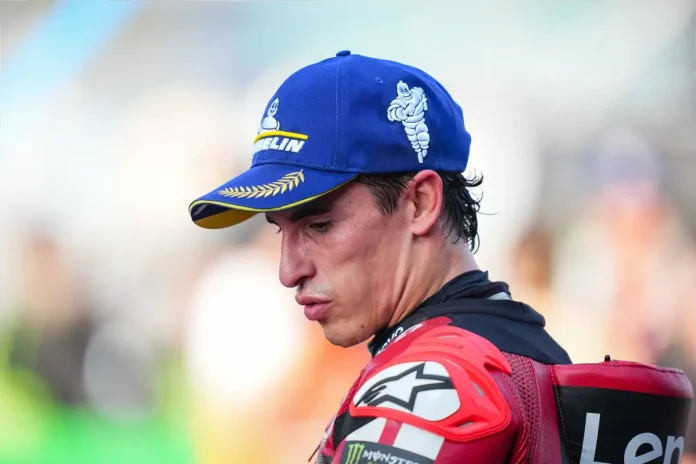
The stakes couldn’t be higher for Marc Marquez as he gears up for the Brazilian Grand Prix, following a frustrating early exit in Thailand just weeks earlier. On the surface, the mission seems straightforward: earn some much-needed points. However, behind the scenes, uncertainty looms large. Even within the Ducati camp, whispers suggest that this weekend might not play to Marquez’s strengths, and the implications could be profound.
Officially, Marquez has had a three-week window to recover from the toll of racing. Unofficially, concerns about his fitness remain palpable. His ongoing shoulder injury, a lingering issue since Mandalika, weighs heavily on his performance. In the physically demanding world of MotoGP, even a minor limitation can quickly escalate into a significant handicap.
The Brazilian circuit is no walk in the park. With nine right turns, it presents a unique challenge that may expose Marquez’s vulnerabilities. Ever since his severe arm injury in 2020, he has struggled to dominate on tracks that require extensive right-hand turns. This relative weakness, while subtle, could prove critical in a sport where every millisecond counts.
Ducati insiders have been candid, stating, “This may not be a circuit where Marc will be at his best.” Such rare admissions underscore a palpable sense of doubt. Yet, there is also a paradox at play. As Jack Appleyard points out, there’s an almost irrational consistency to Marquez’s prowess: “When it comes to quickly adapting to a new track, Marc Marquez is the one who stands out.”
This presents a fascinating contradiction. Marquez, physically compromised, faces a circuit not tailor-made for his style, and rides a bike that has recently struggled against formidable competition from Aprilia. Yet, he is still a competitor who possesses the uncanny ability to flip the script in a matter of laps.
The signal from Thailand was stark: Marco Bezzecchi and Aprilia can no longer be considered mere outsiders. Ducati was bested fairly and squarely, with Marquez not fully in command of the race even before his exit. In essence, victory was far from guaranteed, regardless of the circumstances.
Looking beyond Brazil, a troubling question arises: is this the beginning of the end for Marquez? At 33, he finds himself at a pivotal juncture in his career. He has openly admitted that he doesn’t envision racing into his forties like Valentino Rossi. With his contract running through 2026, he seems inclined towards a shorter commitment. The reason is clear: injuries are stacking up, risks are escalating, and a new generation of riders is emerging.
One name keeps surfacing in conversations: Pedro Acosta. Some, including former racer Alex Barros, speculate that Marquez might opt to retire before he has to confront this new challenger from Ducati head-on.
The Brazilian Grand Prix is far more than just another race for Marquez; it’s a true test. A physical challenge against a demanding circuit, a sporting trial against intensifying competition, and a symbolic examination of his ability to maintain his elite status. If doubts within Ducati are validated on the track, the 2026 season could unfold in ways no one anticipated.