


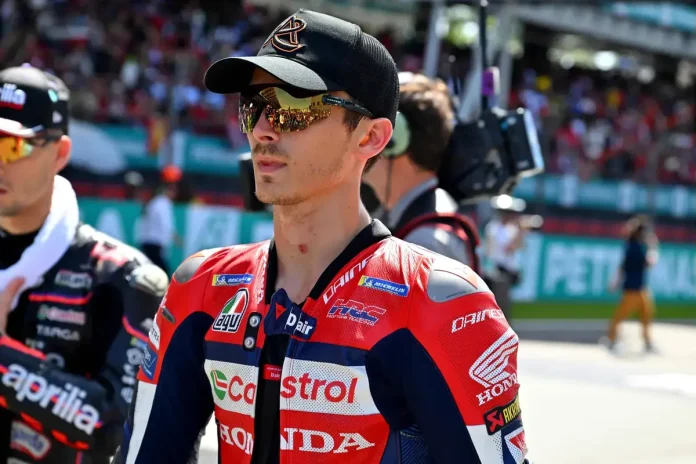
As the MotoGP gears up for one of the most significant regulatory shifts in its history, Luca Marini emerges as a clear voice of reason amidst the swirling excitement. The Italian rider, a pivotal figure in Honda’s gradual resurgence, gazes into the future with a blend of pragmatism and caution. His journey with Honda began two seasons ago, and since then, Marini has played an instrumental role in revitalizing a project that once struggled to find its footing.
The transformation at Honda has been substantial enough to elevate the Japanese manufacturer from Group D to Group C in the concession system starting next season. This critical advancement comes just ahead of the impending technical regulations set to reshape the landscape of MotoGP. However, Marini is quick to temper expectations surrounding these changes, warning that the impact may not be as revolutionary as some might hope.
“The bikes will remain just as extreme. I think the regulatory changes will be minimal, and the tires will represent the biggest novelty,” Marini states, emphasizing that the focus should not solely be on aerodynamic limitations or technical device reductions. Instead, he believes the true game-changer will be the shift in tire manufacturers. “It will be a small revolution: it’s not certain that modifying the regulations will be enough to change things on the track.”
This assertion resonates with many technicians in the paddock, who understand that tire behavior affects everything from chassis dynamics to riding style and race management—far more than any written rule could dictate. While Dorna’s publicly stated goal is to enhance the spectacle, Marini expresses skepticism. “Right now, I don’t see any improvement in the show; on the contrary, I think we can and must do better.”
Marini’s vision extends beyond technical aspects. He yearns for better event quality and enhanced interactions between riders and fans, believing that it isn’t solely Dorna’s responsibility but also that of television networks to elevate the sport. His message is unequivocal: MotoGP must enhance its storytelling, visibility, and marketability, for its potential far exceeds current exploitation. “It’s an incredible sport, and I believe it has the potential to be the best in the world of motorsports.”
Turning his gaze towards the current dominance of Ducati and the existing hierarchy within the grid, Marini acknowledges the prowess of Marc Marquez and the advantages of having the best bike. He candidly states that it was evident Marquez would prevail. Nevertheless, he holds a firm belief that Francesco Bagnaia stands as the one rider capable of challenging Marquez effectively. “I think Pecco will have a great opportunity to redeem himself. It would be wonderful to see him fight again, as for now, he is the only one at Marc’s level.”
Marini does not shy away from his ambitions either, stating, “Honda and I will try to compete with them.” This straightforward declaration carries significant weight for a manufacturer in the midst of a critical rebuilding phase. As the most consistent rider in the paddock, Marini elaborates on how the Honda aids him in pushing limits without succumbing to crashes. “The Honda is a bike that helps you avoid falls,” he explains, highlighting the exceptional feel of the front tire that allows riders to recover in critical situations.
In a MotoGP where the margins are razor-thin, the ability to stay upright can prove more decisive than raw speed alone. Far from engaging in hyperbole or empty promises, Luca Marini presents a sobering yet honest perspective on the future of MotoGP. Yes, 2027 will be a turning point. Yes, tires will be crucial. But no, the magic will not emerge from mere rule changes. For MotoGP to fully harness its potential, it must evolve not only technically and competitively but also culturally.