


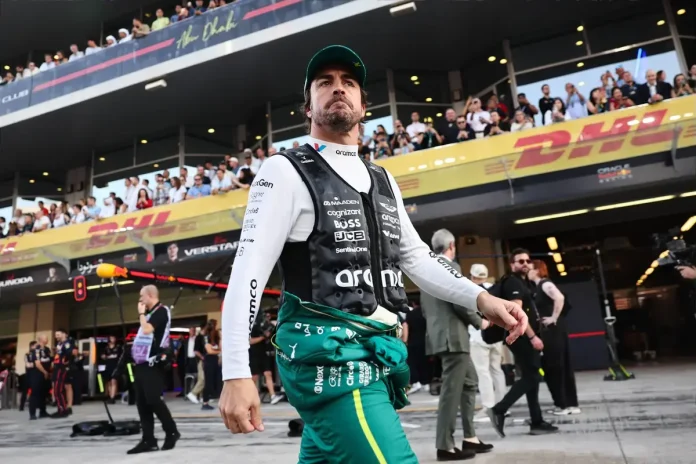
In a gripping exploration of resilience and determination, Fernando Alonso recently lent his voice to the documentary “Volver,” which chronicles the challenging journey of MotoGP superstar Marc Márquez. This powerful film, released by DAZN, dives deep into Márquez’s tumultuous years following his devastating injury in Jerez in 2020, culminating in his triumphant ninth World Championship title. Alonso, a two-time Formula 1 World Champion, drew striking parallels between his own career challenges and Márquez’s relentless pursuit of excellence, showcasing the mental fortitude required to succeed at the highest levels of sport.
Márquez didn’t hold back in expressing his admiration for Alonso, labeling him as “the one who gave the boom in Spain of Formula 1; and the one who has given it a reboom.” He emphasized the impact Alonso has had as a role model, particularly noting his awe for Alonso’s remarkable comeback. “I was truly impressed by this second version of Fernando,” Márquez stated, highlighting the immense difficulty of returning to a sport after a hiatus and reclaiming the status of being the best.
Alonso’s insights into Márquez’s journey reveal a profound understanding of the mental challenges athletes face. He described Márquez’s ability to maintain competitive spirit and drive despite a five-year stretch without titles as “exceptional.” The mental discipline and strength required to continue striving for improvement, even in the face of adversity, is a hallmark of elite athletes. Alonso articulated this sentiment perfectly, stating, “You have to have a mental force and discipline beyond the norm.”
Reflecting on his own return to F1, Alonso acknowledged the challenges that come with stepping away from racing, regardless of the reasons. “When I returned to Formula 1, I thought I would be just as fast as I was two years prior,” he recounted. However, the reality was a stark contrast, as the timing and rhythm of racing had changed in his absence. “The clock told a different story,” he remarked, noting that even the slightest delays in reaction can cost precious tenths of a second on the track.
Alonso elaborated on the cognitive reset that occurs during a break from racing. He likened the process to relearning how to ride a bicycle, emphasizing that even top-tier athletes must reacquaint themselves with the intricate sensations of speed and handling. The mental landscape of confidence versus ego is a delicate balance that he believes is crucial for success in high-stakes racing.
As Márquez navigates his own complex relationship with Honda, Alonso’s perspective sheds light on the psychological battles athletes face when results falter. “When you don’t win for a while and lack the necessary equipment,” he noted, “you must engage in deep self-reflection.” This inner dialogue is vital for maintaining self-esteem and confidence, especially during tough times, as Alonso explained. He emphasized the importance of having unwavering belief in oneself, stating, “You can’t have an ego because that will slow you down.”
In this compelling narrative of two champions, the shared experiences of Alonso and Márquez serve as a testament to the relentless spirit of athletes who refuse to be defined by their setbacks. Their stories inspire not only fans of motorsport but anyone who has faced challenges in their own lives, showcasing the extraordinary resilience found in the heart of a champion.