


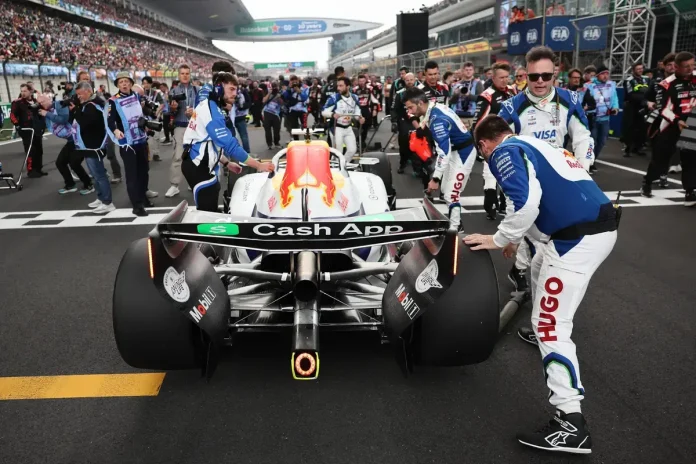
The world of Formula 1 is ablaze with controversy as the sport navigates through a seismic shift in its technical regulations. Fans and drivers alike are expressing growing discontent with the new rules, which many believe have compromised the very essence of racing. In Australia, the statistics might appear favorable at first glance, with a staggering 120 successful overtakes recorded. However, the excitement witnessed on the track masks deeper issues that have sparked fierce debates among the racing community.
Critics argue that the thrilling wheel-to-wheel battles, reminiscent of the sport’s glorious past, are now overshadowed by artificial enhancements. The introduction of new technological gadgets, designed to replace the much-maligned DRS, has altered the fabric of racing, leading to accusations that the sport has strayed far from its roots. The essence of skill and bravery that once defined F1 has been diluted, replaced by mechanisms that some liken to video game mechanics. Max Verstappen, a prominent voice in this discourse, has not held back, stating, “Quiconque comprend la course automobile ne peut pas aimer ça. Ce n’est pas bon pour le sport ; au contraire, cela montre à quel point tout est compliqué.” His sentiments echo through the paddock, resonating with those who yearn for a return to pure racing.
Carlos Sainz has echoed Verstappen’s concerns, lamenting the disconnect between skillful driving and the reliance on technology. He reflected on the drastic speed differences caused by the new systems, noting, “Ce n’est pas une véritable manœuvre de dépassement.” The nostalgia for the days when driver prowess reigned supreme is palpable among seasoned racers, who feel that the sport’s integrity is at stake.
Yet, amidst the clamor, not all drivers reject the new framework. Charles Leclerc, embroiled in a thrilling competition with Lewis Hamilton during the Chinese Grand Prix, attempted to downplay the artificiality of the changes. From his perspective inside the cockpit, the adjustments didn’t seem as contrived, although he acknowledged that battery management plays a significant role in determining race outcomes.
The FIA, recognizing the growing skepticism surrounding the new regulations, is contemplating the future of these changes. Nikolas Tombazis, who oversees the single-seater program for the FIA, admitted that discussions are ongoing, stating, “La position des équipes est de conserver les règles actuelles pour les premières courses, puis de tout réexaminer.” The dialogue signals a willingness to re-evaluate the rules based on data collected from the initial races, but the path to any modifications is far from straightforward.
In the world of F1, change is a labyrinthine process, requiring consensus among teams, the FIA, and engine manufacturers. The current regulations, while contentious, are under scrutiny, with potential adjustments on the horizon. However, the clock is ticking, and any amendments will adhere to a structured timeline that necessitates thorough discussions within the F1 Commission and the World Motor Sport Council.
The backdrop of recent events, including the cancellation of the Bahrain and Saudi Arabian Grands Prix, has only added to the uncertainty surrounding the sport. As discussions unfold, the focus shifts to three key technical modifications that could enhance energy management and overtaking capabilities. Among the proposals is an increase in available energy during attack mode, a crucial factor in overtaking maneuvers that now rely on a blend of aerodynamics and electrical power.
The ongoing debates about energy distribution and the potential for adjustments to the active aerodynamic systems point to a desire for more authentic racing experiences, where drivers can showcase their skills without the crutch of technology dictating the outcomes. The aim is to create a scenario where the attacking driver has a genuine advantage, steering clear of the reliance on DRS while still embracing innovation.
As the F1 landscape continues to evolve, the juxtaposition of traditional racing against a backdrop of technological advancement raises profound questions. Are fans witnessing the dawn of a thrilling new era, or merely a video game on wheels? With the 2026 season looming large, it promises to be one of the most contentious chapters in the sport’s storied history, igniting debates that could reshape the future of Formula 1 for years to come.