


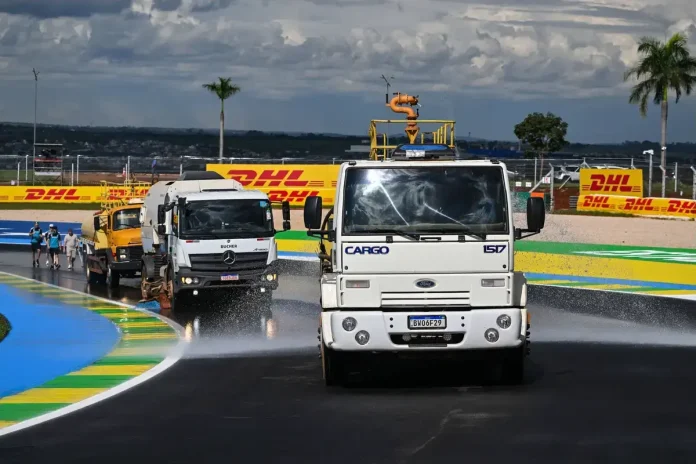
The roar of engines and the thrill of competition are set to ignite the Brazilian landscape as MotoGP makes its grand return to Brazil after nearly two decades. This time, the spotlight shines on Goiânia, a circuit that first opened its doors back on July 28, 1974. Notably, it hosted the first three editions of the Brazilian Grand Prix from 1987 to 1989, exclusively for the 250cc and 500cc categories. The excitement surrounding this event is palpable, especially given that the last MotoGP race in Brazil took place in 2004.
A staggering investment of 240 million Brazilian reais (approximately 40 million euros) has been poured into renovations that have transformed the Goiânia circuit into a modern racing venue. This circuit joins the ranks of Caruaru and Londrina as one of the three Brazilian tracks carrying the revered name of Ayrton Senna, a tribute to the legendary driver whose legacy continues to inspire.
According to Brembo’s technicians, who have collaborated with MotoGP riders for an impressive 11 years, the Goiânia – Ayrton Senna circuit spans 3.835 kilometers and is notorious for its challenging braking conditions. With a difficulty index rated at 4 out of 6, the circuit presents seven braking points per lap, categorized into three difficult, three medium, and one easy. Remarkably, every braking point, except one, demands deceleration rates of at least 1.3 g, contributing to an intense braking duration of approximately twenty seconds per lap.
The most formidable challenge for riders is undoubtedly the first turn, where speeds plummet from a staggering 337 km/h down to 117 km/h in a gripping 4.4 seconds. During this critical braking phase, riders travel 259 meters while exerting a force of 5.6 kg on the brake lever, experiencing a deceleration of 1.5 g. The braking system pressure reaches a staggering 12 bars, underscoring the intense physical demands placed on the competitors.
On the Brazilian front, Diogo Moreira has emerged as a beacon of national pride after clinching the Moto2 world championship last November in Valencia. This achievement marks a historic milestone as he became the first Brazilian to secure a world championship under the FIM’s banner. Riding the Kalex for Italtrans Racing, equipped with a Triumph engine and Brembo calipers reminiscent of those found in MotoGP, Moreira’s victory has ignited a fervor among Brazilian fans.
Moreira made his MotoGP debut with a respectable 13th place finish on the Honda of the LCR team. The distinctions between his Moto2 Kalex and his MotoGP machine are significant, especially with the braking systems. Moto2 utilizes 300 mm steel discs, whereas the premier class bikes boast carbon discs ranging from 320 to 355 mm in diameter. The 320 mm discs are reserved for less demanding circuits, while the larger 355 mm discs are essential for the toughest tracks. Brembo also offers 340 mm discs in various configurations, including Ultra Light and High Mass options.
The legacy of Brembo in racing is storied, having made its first appearance in the premier class back in 1976, but it wasn’t until 1988 that the Italian brand celebrated its first Brazilian victory. Eddie Lawson triumphed aboard a Yamaha from the Giacomo Agostini team, finishing a remarkable 13 seconds ahead of the competition with the aid of 320 mm Brembo discs and four-piston calipers. Lawson’s 1986 YZR500 OW81 was groundbreaking, being the first bike to utilize the radial master cylinder from Brembo, a technology that quickly became the standard for racing motorcycles and is now a staple in high-performance street bikes.
As the world turns its eyes to Brazil, the anticipation for the MotoGP event at Goiânia is electric. With skilled riders like Diogo Moreira leading the charge and the advanced engineering of Brembo’s braking systems in the spotlight, this race promises to be a spectacular showcase of speed, skill, and the relentless pursuit of victory. The stage is set, and the countdown has begun.