


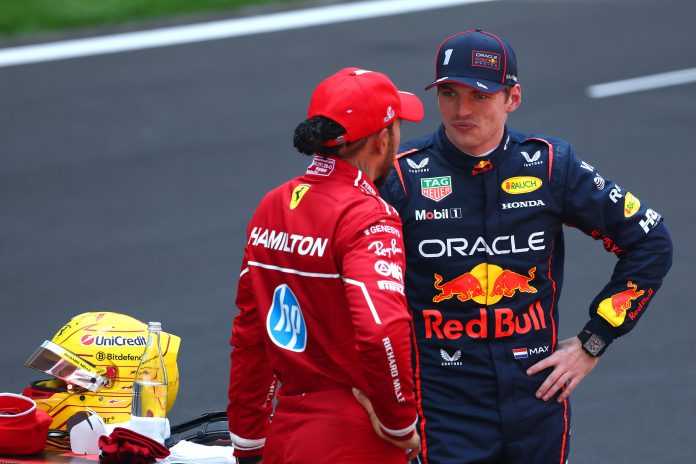
In the high-octane world of Formula 1, a seismic shift is underway, as Max Verstappen boldly dissects the struggles of seven-time champion Lewis Hamilton in a stunningly candid analysis. The 2025 season has seen Hamilton grappling with the challenges of transitioning from Mercedes to Ferrari, a move that has only intensified the difficulties he has faced since ground-effect cars made their entrance into the sport. This isn’t just another rivalry; it’s a clash of eras, ideals, and sheer talent, with Verstappen stepping into the spotlight to deliver an unvarnished truth about the relentless passage of time in racing.
Verstappen and Hamilton’s rivalry has been a defining narrative in modern Formula 1, characterized by contrasting driving philosophies and a pivotal turning point in 2021 that set the stage for their ongoing divergence. While the Dutchman has consistently expressed respect for his predecessor, he refuses to sugarcoat the harsh realities of their sport. In a recent interview, Verstappen laid bare the challenges Hamilton faces in adapting to a new team environment that feels foreign after over a decade with Mercedes, a period during which he amassed an astonishing 84 victories and six world titles.
“Leaving Mercedes after eleven seasons is not just a change; it’s like leaving a second family behind,” Verstappen stated, emphasizing the emotional and professional toll this transition entails. The implications are staggering—Hamilton is now navigating the complexities of a team where his new teammate, Charles Leclerc, has already established his place, making adaptation all the more daunting.
Leclerc, the face of modern Ferrari, is well-versed in the team’s nuances, strengths, and weaknesses, while Hamilton finds himself in a position where he must bend to the demands of a system that doesn’t cater to his past achievements. As Verstappen poignantly observed, “If you don’t feel safe or comfortable within the team dynamic, you can’t be yourself, and that impacts your performance.”
But the most provocative assertion came when Verstappen tackled the sensitive topic of age. “Age doesn’t work in your favor. You won’t be faster at this age. Not necessarily slower, but certainly not faster. Meanwhile, Charles continues to progress,” he stated, cutting straight to the core of the issue. At 40, Hamilton is at a crossroads where the explosive potential of youth is no longer on his side. The ultra-technical realm of F1, where aerodynamics reign supreme and confidence in the car is paramount, leaves little room for hesitation—something that can prove disastrous on the track.
Statistics paint a stark picture, revealing Hamilton’s staggering 86-point deficit to Leclerc in the championship standings. This gap is not merely a reflection of raw talent or experience but a culmination of factors: a late adaptation to a new environment, a demanding car, and, most importantly, the unrelenting march of time itself. Verstappen’s commentary does not condemn Hamilton; instead, it highlights a brutal reality that F1 is notorious for—no one is shielded from the harsh truths of performance.
As the 2025 season unfolds, even a driver of Hamilton’s legendary stature must confront a fundamental and ruthless truth: in the relentless world of Formula 1, time waits for no one. The race continues, and the only constant is change.