


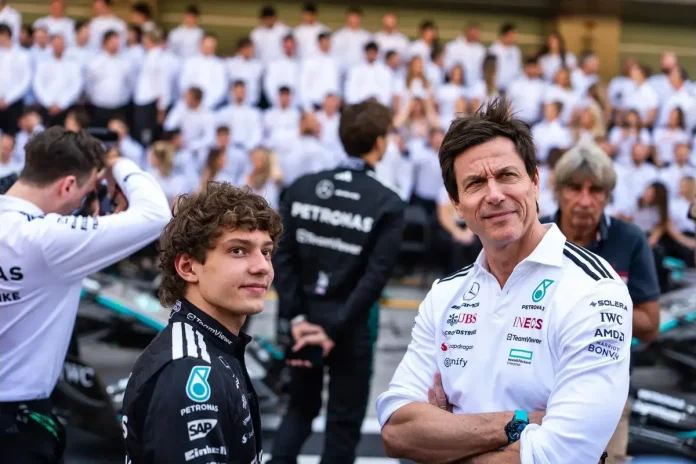
In a stunning revelation that could reshape the landscape of Formula 1, Toto Wolff, the commanding figure at Mercedes, has taken a cautious stance on the immense hype surrounding the team’s prospects for the 2026 season. As the world anticipates a seismic shift with the introduction of new regulations mandating a hybrid powertrain split evenly between engine and electric power, many fans and analysts are quick to proclaim the resurgence of Mercedes, a team that dominated the hybrid era from 2014 to 2021, racking up an astonishing eight constructors’ titles and seven drivers’ championships with the likes of Lewis Hamilton and Nico Rosberg.
Despite the overwhelming optimism that surrounds the Brackley-based team, Wolff’s mindset remains firmly rooted in realism. “Well, I would very much hope so. But I’m a notorious pessimist, and the glass is always half empty rather than half full,” he candidly stated during a recent Mercedes debrief video. This admission underscores a philosophy that champions cautious ambition over blind optimism, leaving fans and rivals alike questioning the true potential of Mercedes in the coming years.
Wolff elaborated on the team’s internal goals, expressing uncertainty about whether they have set ambitious enough targets for both the power unit and chassis. “Whether those targets were ambitious enough, whether we have missed the trick… whether our execution is going to be as faultless as it should be? I don’t know,” he confessed. This level of introspection and honesty speaks volumes about the challenges that lie ahead.
As the 2026 season approaches, all eyes will be on the pre-season testing, scheduled for late January and then again in Bahrain, where Wolff predicts “some glimpses of performance balance.” However, he emphasizes that the key to success will be the relentless development of their tools throughout the season, a strategy that could either cement their legacy or expose their vulnerabilities.
Adding another layer of intrigue, Sky Sports F1 analyst Bernie Collins highlighted that Mercedes will be supplying power units for three teams in 2026: Alpine, McLaren, and Williams. This strategic move could provide Mercedes with a unique advantage. “I think the status quo will change among the teams because I think it’ll be who gets the engine right and who gets the engine wrong,” Collins remarked, hinting at a potentially tumultuous competitive landscape.
The implications are profound. While many assume that Mercedes engine teams will rise to the top, the reality is shrouded in uncertainty. Collins pointed out that, unlike Honda, which only supplies one team, Mercedes’ alliance with three teams means they will have an accelerated learning curve, potentially allowing them to outpace their competitors in engine development.
With Wolff’s cautious optimism and the strategic advantages of supplying multiple teams, the 2026 season promises to be a thrilling chapter in Formula 1 history. As the motorsport world gears up for what could be a dramatic transformation, fans are left wondering: will Mercedes reclaim its throne, or will the shadows of doubt cast by Wolff become a self-fulfilling prophecy? The answers may lie just around the corner, and the stakes have never been higher.