


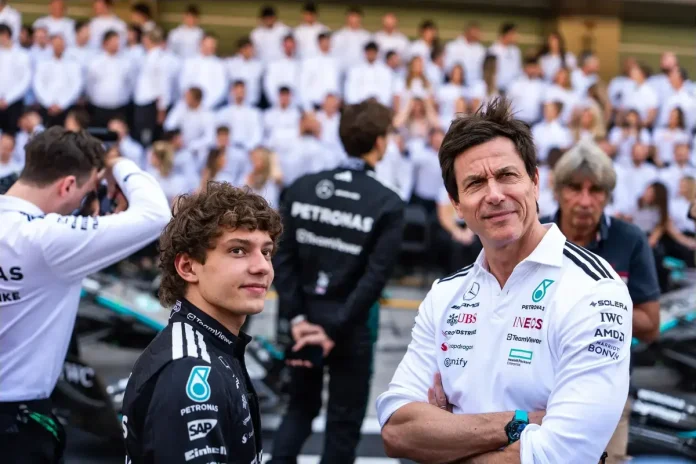
Toto Wolff, the mastermind behind Mercedes’ F1 operations, has thrown down the gauntlet, questioning the audacity of the team’s ambitions as they gear up for the seismic shift in regulations set to rock Formula 1 in 2026. With a reputation for excellence and innovation, Mercedes finds itself at a crucial crossroads, pondering whether their targets are truly visionary enough to maintain their dominance amid sweeping changes.
As the countdown to the 2026 rules revolution continues, expectations are sky-high for Mercedes, who are widely viewed as the frontrunners in this new era. The upcoming overhaul promises radical transformations to both the power unit and chassis, reminiscent of the groundbreaking transition that introduced turbo hybrids back in 2014. Under the new regulations, power units are set to harness a staggering three times more electrical energy, reaching up to 350kW, while bidding farewell to the MGU-H component and embracing 100% synthetic fuels. This is more than just a technical adjustment; it’s a fundamental shift that could redefine the sport.
In a striking move, on-track testing for this next-generation vehicle is just around the corner, commencing next month with clandestine trials in Barcelona, followed by the official pre-season testing in Bahrain come February. Yet, despite the imminent testing phase, Wolff expresses palpable uncertainty about whether Mercedes has adequately prepared for the impending revolution. He candidly articulated his concerns, stating, “It is super difficult to predict. Because we set ourselves targets that we are on track to meet, but whether those targets we set were ambitious enough, and whether those targets have been set in the right place in terms of priorities, only the future will show.”
Wolff reflected on past experiences, drawing parallels between the current situation and a pivotal moment in 2013 when he was frantically calculating championship points in a press conference. He recalls, “I remember [in 2013] the press conference in Brazil where I was calculating with a pen and paper what points we needed to finish second in the championship, we ended up winning three races, and the P2 was certainly a lot more cheerful than [2025], considering where we came from.” This historical context underscores the intensity of competition in the current landscape and the unpredictability that lies ahead.
The stakes have never been higher, as Wolff noted that the current grid is more competitive than ever before, emphasizing that past successes cannot be easily replicated. “In 2014, I had the feeling already in the winter when we were the first ones running a full car dyno, the engine was more reliable than with others, and on day one of testing, nobody did the laps we did, and it was the same on day two. So it is not comparable, I would say that the grid is just much more competitive than it was in previous years.”
As Mercedes navigates this tumultuous transition, all eyes will be on Wolff and his team to see if their ambitions can match the monumental challenges ahead. The 2026 season promises not only to test the mettle of the Mercedes squad but to reshape the entire landscape of Formula 1 racing. Will they rise to the occasion, or will this be the moment their dominance begins to fade? The answers will soon unfold on the asphalt of Barcelona and beyond.