


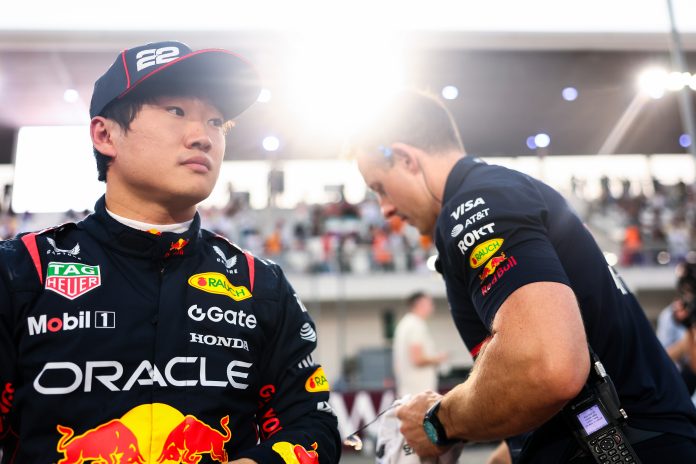
Red Bull Racing has ignited a firestorm of speculation and excitement with its 2026 Formula 1 driver line-up announcement, ushering in a bold new era that leaves Yuki Tsunoda in the dust. The team has opted for Isack Hadjar to partner with reigning champion Max Verstappen, while the promising Arvid Lindblad steps into a crucial role alongside Liam Lawson. This shocking reshuffle has left Tsunoda without a seat on the grid, demoting him to a reserve role just as he aimed for a breakthrough that has now evaporated before his eyes.
Hadjar’s promotion comes on the heels of an impressive season with Racing Bulls, yet the decision raises eyebrows. While Hadjar has shown speed, the question lingers: is he truly ready to battle alongside Verstappen, a driver who has redefined dominance in F1? Veteran analyst Gary Anderson points out that Red Bull had limited options, and while Hadjar’s raw talent is undeniable, the pressure of consistently delivering podium finishes might prove overwhelming. With new regulations in play for 2026, Hadjar finds himself on a level playing field, but matching Verstappen’s prowess will be no small feat.
Meanwhile, the retention of Lawson is seen as a strategic move for stability. After a shaky stint in the Red Bull seat, Lawson has the potential to shine in a supportive role. Yet, Lindblad’s inconsistency in Formula 2 raises questions about his readiness for the high-stakes world of F1. This season presents an opportunity for him to prove his worth, but the pressure to perform is palpable.
The narrative takes a sharp turn as Jack Benyon unleashes a scathing critique of Red Bull’s decision-making. He argues that the answer to their second driver dilemma was all too clear last year—Carlos Sainz. The missed opportunity to secure Sainz’s talents is a glaring error, especially when considering his impressive performances in a midfield car. Benyon contends that Hadjar’s promotion, while justified on some level, doesn’t necessarily reflect exceptional performance compared to his predecessors.
As the dust settles, the conversation shifts back to Tsunoda. Analyst Scott Mitchell-Malm highlights the systemic issues within Red Bull that contributed to Tsunoda’s downfall. His in-season promotion deprived him of essential preparation time, and although he showed flashes of potential, they were often overshadowed by team errors. The verdict is clear: while Tsunoda may not have consistently delivered, the blame does not rest solely on his shoulders.
In a twist of fate, Lawson’s rocky start at Red Bull may have inadvertently safeguarded his place for 2026. Tsunoda’s claims of being disadvantaged without proper pre-season testing resonate, but the harsh reality is that F1 is unforgiving. Results are paramount, and Tsunoda’s trajectory has been marred by missed opportunities and insufficient performance.
The conversation about Tsunoda’s future is laced with nostalgia, reminiscent of past underdog stories like Super Aguri. While some may dream of a resurgence for Tsunoda, the current landscape suggests he may be relegated to the sidelines, a victim of circumstances rather than a lack of talent. The potential he displayed at times only amplifies the disappointment of what could have been.
As Red Bull charts a new course, the stakes are higher than ever. The success of Hadjar and Lindblad could dictate the team’s future, but the specter of Tsunoda’s unfulfilled promise lingers. The reshuffle may signal a necessary reset, but it also serves as a poignant reminder of the cutthroat nature of Formula 1, where only the most exceptional thrive and dreams can shatter in an instant.