


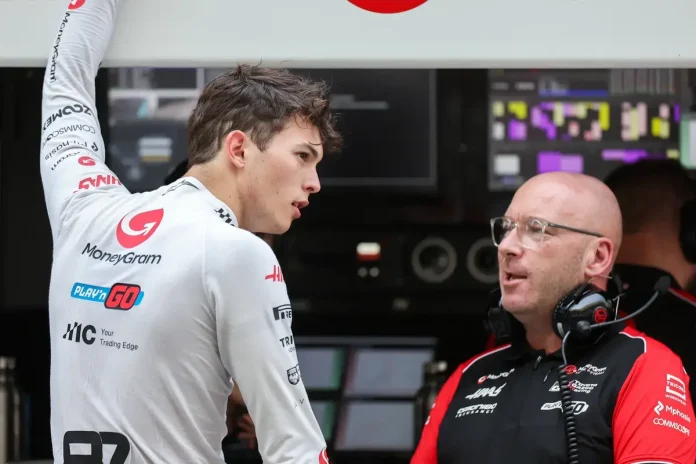
Oliver Bearman, the promising Haas driver, has turned heads this season with a remarkable transformation in his approach to racing, leading to significant improvements in his performance during the 2025 Formula 1 season. Finishing 13th in his rookie year, Bearman has not only outpaced his more experienced teammate Esteban Ocon but has also emerged as a formidable competitor on the track, particularly in the latter half of the season.
His resurgence was highlighted by a string of impressive results following the summer break, where six out of his nine points finishes came after August’s Dutch Grand Prix. A particularly standout performance was his fourth-place finish in Mexico, where he was a contender for the podium for much of the race, marking a stark contrast to his earlier difficulties in the season. Before the summer, Bearman faced a long stretch of nine races without scoring any points, a period of frustration that he attributes to a lack of structure in his race weekend approach.
Reflecting on the pivotal changes that led to his recent success, the 20-year-old revealed, “Since the summer break, I tried to add a bit more structure to my weekends, how I go about the weekends.” This newfound focus on mental preparation has been crucial. Bearman acknowledged that prior to his adjustments, he was overly fixated on improving car setup and his driving technique, often neglecting his mental state before getting into the car. “Now, just making sure that half an hour before the session, I stop working on the set-up and the driving and all of those things and focus on my mental side. I found that to be quite useful,” he explained.
Bearman’s journey as a rookie has been characterized by the necessary growing pains of learning and adaptation, which he views as essential to his development as a driver. “In the first half of the season, I finished P11 four or five races in a row, so it’s not like I was doing a terrible job,” he reflected, acknowledging the inconsistency that plagued him early on. “There was definitely a lack of consistency, but the only way of knowing what to do is by doing those mistakes.”
He candidly admitted that while he could envision a different outcome had he implemented his current strategies earlier, the lessons learned through trial and error were invaluable. “The first half of the season is purely exploratory and has to be that way because you have to find what works for you and what doesn’t,” Bearman noted, emphasizing the distinct challenges of F1 compared to his previous racing experiences.
Looking back on his inaugural season, Bearman expressed a sense of satisfaction with his progress. “I’ve been happy with it,” he stated. “That’s not to say that I’m a perfect and polished driver because I still have a lot to learn and I’m aware of that.” His self-awareness is a testament to his character and determination to evolve in one of the most demanding sports in the world.
The young Brit believes that the structure he has integrated into his race weekends has been instrumental in building momentum and rhythm, key components for success in F1. “I feel like I’ve found some momentum and rhythm,” he said, recognizing that these elements are not solely about individual performance but also about accumulating experience over the course of the season.
As Bearman gears up for future races, he carries with him the lessons of his rookie year, ready to tackle the challenges ahead with a renewed mindset and a clearer strategy. His journey underscores the resilience and adaptability needed to thrive in Formula 1, and with each race, he is not just racing against his competitors but also against the limitations of his own potential.