


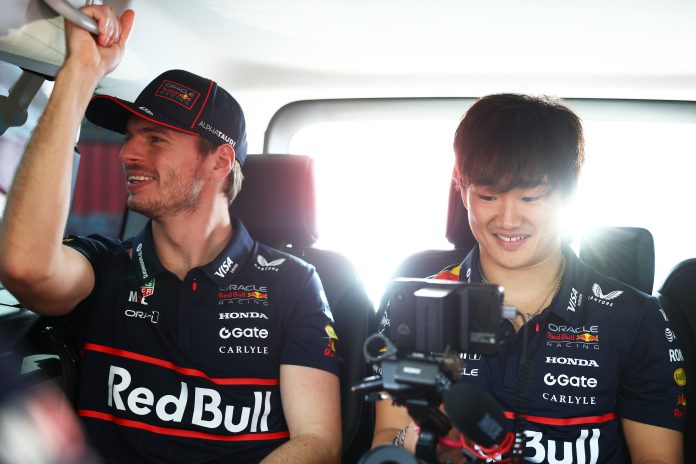
The drama unfolding at Red Bull Racing is nothing short of a captivating saga in the world of Formula 1. As the countdown to the 2026 season begins, the team is poised to welcome yet another new face alongside the unstoppable Max Verstappen. With Isack Hadjar stepping in to replace Yuki Tsunoda, Verstappen will be racing with his fourth different teammate in just two years, leaving fans and pundits alike questioning what has gone wrong in the second seat.
The reality of the situation is stark: the second seat at Red Bull has become synonymous with struggle and disappointment. The likes of Sergio Perez, Liam Lawson, and Tsunoda have all failed to keep pace with the Dutch phenom, leading to a perception that the role is akin to a poisoned chalice. Renowned F1 champion Jacques Villeneuve, who has experienced his own share of battles on the track, has dissected this puzzling phenomenon with keen insight.
Villeneuve recently shared his thoughts on the High Performance podcast, shedding light on why drivers frequently falter when matched against Verstappen. He dismisses the common narrative that the car is uniquely tailored for Verstappen, arguing instead that it’s the reigning champion’s relentless pursuit of excellence that sets him apart. “Everybody’s been saying, ‘Oh, but the car is made for Max. Poor, poor second driver.’ Actually, no. Max is working on it, making the car better and better,” Villeneuve asserts.
The crux of the issue, according to Villeneuve, is not merely about the car’s configuration but the ability of the drivers to adapt and grow with it. He highlights a crucial point: those unable to decipher the intricacies of the vehicle’s performance will inevitably lag behind. “If you’re incapable of driving it or figuring out what the issue is during the season, you’ll end up going slower and slower and slower,” he explains. As Verstappen continues to push the limits, his teammates find themselves spiraling into a performance abyss.
This pattern has been alarmingly consistent. Villeneuve points out that while drivers like Perez may start off on equal footing, Verstappen’s ability to understand and optimize the car’s dynamics sees him pulling away as the season progresses. “Max started going faster and faster and faster,” Villeneuve notes, emphasizing the stark contrast in their developmental trajectories.
Understanding the car’s behavior is key, and Villeneuve elaborates on the challenges drivers face in this high-stakes environment. “Sometimes you’ll have understeer because the front is too soft, other times because it’s too stiff,” he explains. The balance between mechanical grip and aerodynamic efficiency is a delicate dance that only a few drivers master. The best configurations allow the car to feel like an extension of the driver’s body, melding seamlessly with their intentions.
As Red Bull prepares for another season, all eyes will be on Hadjar as he takes on the formidable challenge of being Verstappen’s teammate. Will he rise to the occasion or fall prey to the same issues that have plagued his predecessors? The unfolding drama promises to be as electrifying as the races themselves, with fans eagerly anticipating whether Hadjar can break the cycle of underperformance and carve out his own legacy alongside one of the sport’s greatest talents. The stakes are high, and the pressure is palpable—the second seat at Red Bull is not just a position; it’s a battleground where only the most adept will survive.