


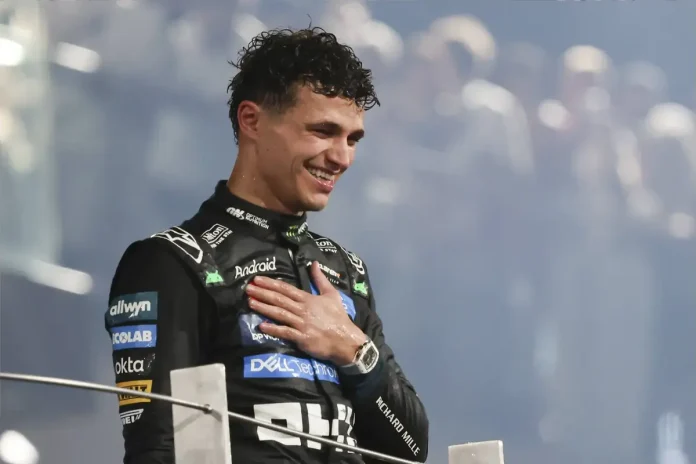
Lando Norris has taken a bold stand against the narrative that his unexpected retirement at the Dutch Grand Prix served as a catalyst for his stunning ascent to the Formula 1 title. Instead of being a moment of relief, Norris insists that the setback only intensified the pressure on him to perform at his absolute best.
In a dramatic finale at Abu Dhabi, Norris secured his inaugural Drivers’ Championship, overcoming fierce competition from reigning champion Max Verstappen and his McLaren teammate, Oscar Piastri. Just months earlier, in late August, things looked grim for Norris as he found himself languishing 34 points behind Piastri, largely due to a devastating oil leak that forced him out of the race at Zandvoort.
However, what followed was nothing short of extraordinary. Norris embarked on a relentless comeback that saw him close the gap and ultimately seize the title over the next six races. While he previously expressed a newfound sense of calm regarding the championship pursuit, he is adamant that this wasn’t a product of feeling less pressure, but rather an acknowledgment of the mountain he had to climb.
“I honestly would just want to say no. It didn’t allow me to relax,” Norris stated firmly when questioned about the impact of his retirement. He explained that staring down a 34-point deficit against a teammate who was performing remarkably well did not instill any confidence. “It wasn’t like, ‘I got nothing to lose now, I can just go.’ I felt like I was trying to do everything I could before, and I continued to try and do everything I could after.”
Norris revealed that the key to his turnaround lay not in a lighter mindset, but in a harder, more focused approach to his training and preparation. “I just had to step up what I was doing away from the track,” he elaborated. By expanding his support team and enhancing his work ethic both in the simulator and at the racetrack, he was able to unlock new levels of potential.
“I had to dig deep and try to understand more things quicker and in a more advanced way than I ever have before,” he explained. Far from feeling liberated by his deficit, Norris was driven by the urgency of the situation. “I was like, ‘Oh, shoot. I’m quite a long way behind against a pretty freaking fast driver, and I’ve got to step it up.’”
This relentless pursuit of excellence ultimately culminated in a string of outstanding results that clinched him the championship. Norris credits his success to a combination of personal determination and the strategic enhancement of his team, saying, “I got to be more myself because of external factors – working with more professionals in different areas to unlock more of my ability.”
In a sport defined by razor-thin margins and fierce rivalries, Norris’s triumphant narrative reinforces the notion that true champions are forged in the fires of adversity, proving that setbacks can indeed be stepping stones to greatness.