


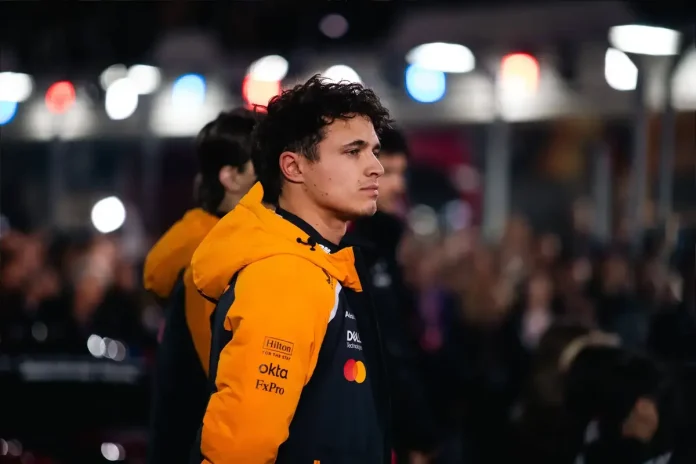
Lando Norris has achieved what every aspiring Formula 1 driver dreams of: clinching the world championship title. But with great success comes an equally staggering price tag. As he revels in his triumph from the 2025 season, Norris faces the monumental task of paying over one million euros to secure his Super Licence for 2026—the most expensive bill in the paddock, a true “tax on success” that underscores the exorbitant cost of glory in the high-octane world of F1.
The young British driver, who amassed an impressive 225 points during his championship-winning year, now finds himself confronting a financial reality that many may not fully grasp. To keep racing, Norris must lay down a jaw-dropping sum of 1,023,507 euros solely for the privilege of competing, courtesy of the FIA’s Super Licence system, which directly ties the cost to performance metrics. The formula is unforgiving: a base fee of 11,842 euros is supplemented by 2,392 euros for every point he scored in the previous season. The math is as relentless as the competition.
This “winner’s tax” is not just a footnote; it places Norris at the top of a dubious leaderboard, where only he and fellow champion Max Verstappen, who previously hit a staggering 1.3 million euros, share the distinction of paying such a hefty fee. The implications are vast—this system can financially penalize drivers based on their success, creating a significant hurdle for emerging talents and those racing with less prominent teams.
In this financial landscape, other drivers have also felt the impact of their performances. Carlos Sainz, for instance, finds himself in a more fortunate position. After a less prolific 2025 season compared to his previous year with Ferrari, he benefits from a reduced fee, saving over half a million euros. Similarly, Charles Leclerc sees his financial obligation decrease by 250,000 euros, reflecting a challenging year with the Scuderia.
However, not all stories are of relief. Oscar Piastri, riding high after a commendable third-place finish in the championship, faces a staggering rise of over 336,000 euros in his licence fee. George Russell and Fernando Alonso also feel the pinch of their successful seasons, joining the ranks of those burdened by increased costs.
The exclusivity of the “million club” in 2026 is a testament to sustained excellence at the pinnacle of motorsport, with only Norris and Verstappen crossing this monumental threshold. Critics of the system argue that it unfairly penalizes high achievers, particularly younger drivers or those representing smaller teams who manage to score significant points. For instance, Piastri, whose market value is soaring, finds a considerable chunk of his earnings consumed by this hefty licence fee.
Yet for established stars like Norris and Verstappen, who command salaries in the tens of millions, this expense, while considerable, is merely a line item in their financial planning, often covered by their teams or factored into contract negotiations. It’s the cost of competing at the apex of the world’s most exclusive and lucrative sport.
Norris’s Super Licence fee extends beyond mere numbers; it encapsulates the paradox of Formula 1. A realm where triumph is celebrated with trophies and accolades, yet the right to compete is shackled to a staggering administrative burden. Achieving the title is not just about glory; it’s a reminder that in F1, success comes with a price—one that is steep, and one that champions like Norris must pay to continue their reign in the fast lane.