


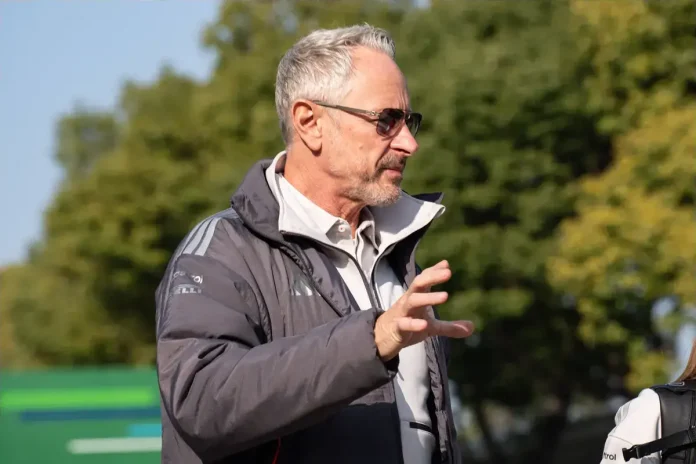
In a dramatic turn of events, Jonathan Wheatley has made headlines with his departure from Audi F1, a move that has sent shockwaves through the motorsport community. Wheatley, who previously held the role of sporting director at Red Bull, has now set his sights on Aston Martin, where he is tipped to take on the significant role of team principal. This transition comes hot on the heels of a deep discussion with Mattia Binotto regarding the future of Audi’s power unit for the 2026 Formula 1 season.
Wheatley’s exit from Audi was confirmed just days after he engaged in a “long conversation” with Binotto, the former Ferrari mastermind who now leads Audi’s ambitious F1 project. The discussions revolved around the critical development of Audi’s engine, which has emerged as a focal point of concern as the team navigates its inaugural season. Despite having made strides, including a memorable podium finish with Nico Hulkenberg at the British Grand Prix, Audi has faced challenges, including a disappointing DNS in both Melbourne and China, underscoring the need for improvements.
After the team’s first two races, Wheatley candidly admitted that the Audi engine requires significant attention. He stated, “We’re careful about what we say in public about it. One of the areas of focus for us in the next development cycle is the PU. We think there’s some work that we can do in that area.” The admission highlights a critical vulnerability in Audi’s performance, particularly in terms of driveability—a factor that became glaringly evident in wheel-to-wheel battles, as seen in Hulkenberg’s struggles during the race in China.
Wheatley identified driveability as an ongoing issue, explaining how it hampered their ability to compete effectively: “I think it’s a track that exposed our weaknesses in many areas.” His insights suggest that the Audi team has significant work ahead to refine their engine’s responsiveness in competitive racing scenarios, particularly when quick reactions are needed.
While discussing the technical challenges, Wheatley was careful not to delve too deeply into specifics that would tread on Binotto’s expertise. He remarked, “You’re getting very close to Mattia-type questions and not Jonathan-type questions!” This playful acknowledgment of Binotto’s extensive knowledge of power unit dynamics only adds to the intrigue surrounding Audi’s engine development.
Wheatley’s impressive track record includes pivotal contributions to Red Bull’s dominance in the sport, specifically in refining pit stop strategies. His ability to enhance team performance was also evident at Sauber, where he played a crucial role in the team’s transformation ahead of Audi’s entry. As he prepares for his new chapter at Aston Martin, Wheatley is expected to bring his wealth of experience and strategic vision to a team that is eager for success.
Amidst this whirlwind of activity, Aston Martin’s executive chairman, Lawrence Stroll, has publicly expressed unwavering confidence in Adrian Newey’s leadership amidst swirling speculation. Stroll emphasized that Newey remains a vital figure within the organization, focused on the team’s strategic and technical direction while supported by a capable senior leadership team. This assurance serves to reinforce Aston Martin’s commitment to maintaining a unique operational structure that diverges from traditional team dynamics seen elsewhere in Formula 1.
As the motorsport world watches closely, the upcoming season promises to be a pivotal one for both Audi and Aston Martin, with Wheatley’s strategic decisions poised to shape the future landscape of the sport. Enthusiasts can expect ongoing updates as the drama unfolds in the high-stakes arena of Formula 1, where every move is scrutinized and every decision could alter the championship race.