


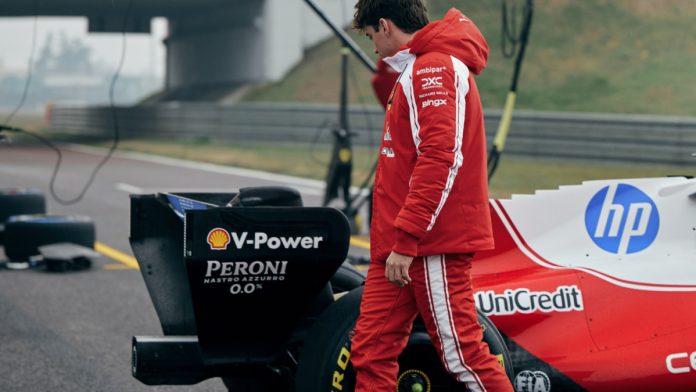
In the high-stakes world of Formula 1, Ferrari’s relentless pursuit of victory, encapsulated in their “win or nothing” philosophy, may be the very anchor weighing them down as they aim for the 2026 championship. Alex Brundle, a keen observer of the sport, has drawn attention to this paradox, suggesting that the very ideals that once propelled the Maranello team to glory could now be their undoing, despite the positive buzz surrounding their latest car, the SF-26.
The Tifosi, Ferrari’s passionate fanbase, are buzzing with renewed hope as the SF-26 made its debut at Fiorano before taking to the Circuit de Barcelona-Catalunya for a crucial private shakedown in January. This early glimpse suggested a promising season ahead, especially following a stellar performance where Lewis Hamilton, now donning the red colors, clocked the fastest lap of the event alongside teammate Charles Leclerc. Hamilton’s endorsement of Ferrari’s “winning mentality” only added to the optimism. “Everyone’s really on it,” he proclaimed, expressing his excitement about the team’s spirit and enthusiasm.
However, history has taught fans to temper their expectations. Ferrari’s pre-season flair has frequently crumbled under the weight of competitive pressure, and Brundle warns that this cycle could repeat itself. He emphasizes that the ethos surrounding Ferrari is less about their capability to win and more a product of a cultural obsession with excellence. “I do think that that is a problem that Ferrari have,” Brundle stated, highlighting the Tifosi’s unwavering demand for grandeur. The brand’s legacy, he argues, is steeped in a narrative where racing triumphs take precedence over commercial success.
The landscape shifted dramatically when Hamilton transferred to Ferrari, a move heralded as one of the most significant in modern F1 history. Yet, the 2025 season was a bitter pill for the seven-time champion, as he concluded the year without a single podium finish for the first time in his illustrious career. This disappointment, Brundle suggests, is not merely a reflection of Hamilton’s waning abilities but rather a confluence of misaligned philosophies and the harsh competitiveness of F1.
Brundle articulates a deeper issue at play. He references Ron Dennis’ famous adage in motorsport: “past performance has no monopoly on future results.” In other words, every race offers a clean slate, and expectations based on history can be misleading. Brundle notes that the current regulatory environment and the car’s characteristics are not particularly suited to Hamilton’s driving style, which thrives on a different kind of car dynamics. The inertia within Ferrari’s established processes, compounded by immense pressure to succeed, creates an environment where even the most revered driver can find himself at a disadvantage.
As the clock ticks down to 2026, the stakes couldn’t be higher for both Hamilton and Ferrari. If they fail to deliver a competitive package, they risk losing not only Hamilton but also Leclerc, a prospect that sends shivers down the spine of every Tifosi. Yet Brundle sees a silver lining: with the end of the ground effects era, Hamilton has a “tremendous opportunity” to influence the development of the new car and help reignite Ferrari’s storied history of success. “He’s got as good a chance as anybody,” Brundle asserts, hinting at the potential for resurgence if the new regulations align with Hamilton’s strengths.
The future holds promise, but it remains shrouded in uncertainty. Will Ferrari’s deep-seated philosophy of victory at all costs ultimately empower them to reclaim their glory, or will it continue to be a double-edged sword that cuts them down when they least expect it? As the F1 season unfolds, all eyes will be on Maranello to see if they can turn their ambitions into reality.