


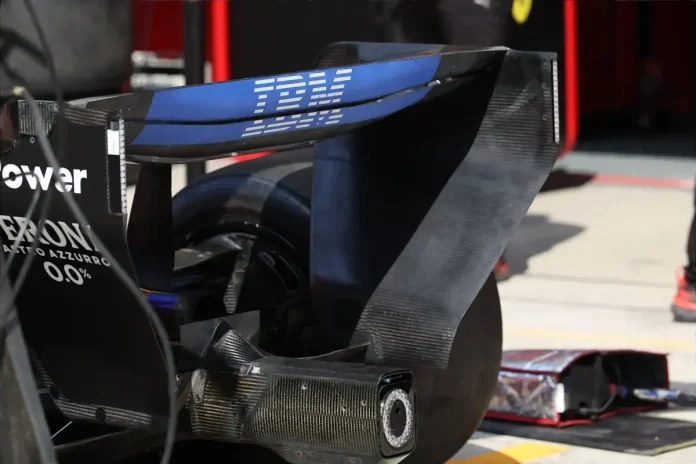
In an electrifying twist ahead of the Japanese Grand Prix, Ferrari’s team principal Fred Vasseur has hinted that the Scuderia will continue to refine its groundbreaking rotating rear wing technology. This cutting-edge component made its race weekend debut during the Chinese Grand Prix, where it stirred excitement and controversy alike. After a mixed bag of results in Shanghai, Ferrari is poised to unleash more of this innovation in Suzuka, showcasing their relentless pursuit of speed and performance.
The rotating rear wing, which first turned heads during pre-season testing, was tested by both Charles Leclerc and Lewis Hamilton during the initial practice session in Shanghai. However, the excitement was short-lived as Hamilton experienced a dramatic spin at the Turn 6 hairpin, prompting Ferrari to revert to a more traditional DRS-style wing for the remainder of the event. Reflecting on the incident, Hamilton candidly remarked that utilizing the rotating wing might have been “maybe a little bit premature,” underscoring the challenges of integrating such advanced technology into a high-stakes race environment.
Vasseur’s analysis of the situation reveals that the team did not accumulate sufficient mileage with the rotating wing during practice to warrant its continued use in the race. With the constraints of a sprint weekend limiting their testing opportunities, Vasseur explained, “We didn’t put enough mileage on the rear wing. And with the system today, you don’t have a test between the races, so that means if we want to put mileage on the parts, we need to do [it in] FP1.” His comments signal a commitment to further experimentation in Japan, with the aim of achieving the reliability needed to deploy the wing for a full race weekend.
Despite the setbacks, Vasseur remains optimistic about the technology, assuring that there are no significant concerns regarding the airflow reattachment when the wing operates. This optimism comes in the wake of comments from other teams who have expressed skepticism about adopting similar innovations for the 2026 F1 season, citing potential drawbacks such as a sail-like effect during the wing’s opening and closing phases. This concern was further highlighted by footage from Hamilton’s spin, indicating that the rear wing was still transitioning when he lost control of his car.
As Ferrari gears up for its next challenge, the eyes of the F1 world will be firmly fixed on the Japanese Grand Prix. Will the Scuderia master the complexities of the rotating rear wing, or will it remain a tantalizing glimpse of what could be? With the balance of technology and driver skill at the forefront, the stakes have never been higher. Fans and analysts alike will be watching closely as Ferrari seeks to harness this innovation for a competitive edge on the iconic Suzuka circuit.