


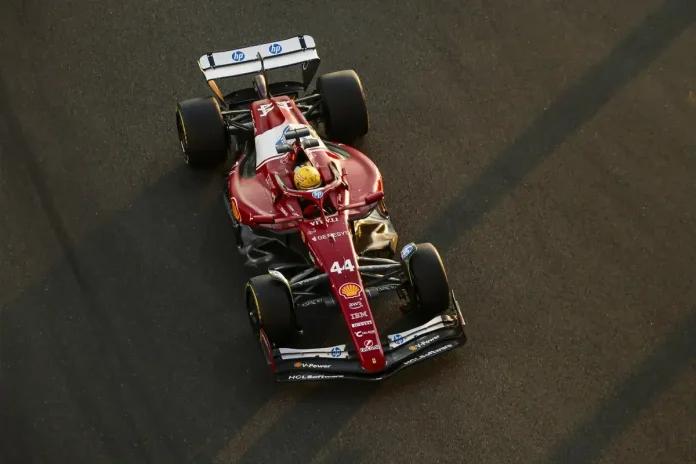
Ferrari’s 2025 Formula 1 journey can only be described as a monumental letdown, culminating in a disappointing fourth-place finish in the constructors’ championship with a mere 398 points and, shockingly, no grand prix victories to their name. This season was anticipated to be a thrilling continuation of their fierce rivalry with McLaren, but instead, it devolved into a disheartening saga marred by adaptation struggles and missed technical opportunities. As the dust settles, the Scuderia is left to ponder whether their decision to halt all aerodynamic development on the SF-25 back in April will bear fruit in the upcoming 2026 season.
The driver lineup of Charles Leclerc and Lewis Hamilton was touted as one of the most electrifying combinations in the sport, yet the performances throughout the grueling 24-race calendar painted a starkly contrasting picture. Lewis Hamilton, stepping into Ferrari for the first time, endured the most challenging season of his illustrious career, finishing sixth in the drivers’ standings without even a single podium finish. For a seven-time world champion, this is a statistic that stings deeply and raises eyebrows across the paddock. Hamilton, who has dominated the sport for years, found himself struggling to keep pace, qualifying an average of almost two-tenths slower than Leclerc and only amassing 64.5% of his teammate’s points.
The difficulties faced by Hamilton were layered and complex. His driving style, meticulously crafted over years with Mercedes, clashed dramatically with the characteristics of Ferrari’s engine and the unforgiving performance window of the SF-25. This mismatch left him appearing dejected during media engagements, visibly grappling with the challenges. His only moment of glory came in the form of a sprint race victory in China, a fleeting highlight in an otherwise bleak season that saw him finish with an average placement of 8.5, a far cry from Leclerc’s 6.75. Despite these setbacks, Hamilton remains resolutely committed to the Ferrari project, acknowledging the steep learning curve while expressing no regrets about joining the iconic Maranello team.
Conversely, Leclerc demonstrated his undeniable talent and racecraft, securing fifth place in the drivers’ championship with a commendable 242 points. He became the beacon of hope for Ferrari, achieving all of the team’s podium finishes, which included impressive second-place results in both Monaco and Mexico. Although victory eluded him, his consistency was pivotal for Ferrari, as he completed all but three races, even amid the turmoil of the team’s double disqualification in China due to plank wear violations.
So what went wrong for Ferrari, and what does the future hold? The technical strategy adopted by the team in 2025 backfired spectacularly. A crucial mid-season decision to prioritize rear suspension modifications over necessary aerodynamic advancements left the SF-25 with an extreme rigidity that hampered its performance. This rigidity proved disastrous, particularly when actual track conditions deviated from simulation predictions. Ferrari learned the hard way that a car’s development priorities must align with its operational flexibility.
After facing disqualifications in China, the team shifted to conservative setups, sacrificing downforce to comply with regulations, which only served to further stifle performance. As eyes turn toward 2026, Ferrari has chosen to retain the Leclerc-Hamilton partnership, navigating the sweeping rule changes that will reshape the landscape of F1. These revolutionary regulations promise a clean slate, with a new power unit structure in which internal combustion and electric power will share the load equally, alongside active aerodynamics and significantly lighter vehicles.
The anticipation is palpable as Ferrari prepares to unveil their 2026 challenger at a launch event in Fiorano on January 23. Team principal Fred Vasseur is placing a strong emphasis on reliability over raw performance at this juncture. The comprehensive overhaul of regulations offers Ferrari a golden opportunity to rectify the mistakes of 2025. With an entirely new power unit architecture and dramatically reconfigured car dimensions, the playing field will be leveled for all teams. For Hamilton, these regulation changes could provide the revitalization he needs to reclaim his championship-winning prowess in the iconic Ferrari red. The stage is set for a dramatic comeback—will Ferrari seize this chance for redemption?