


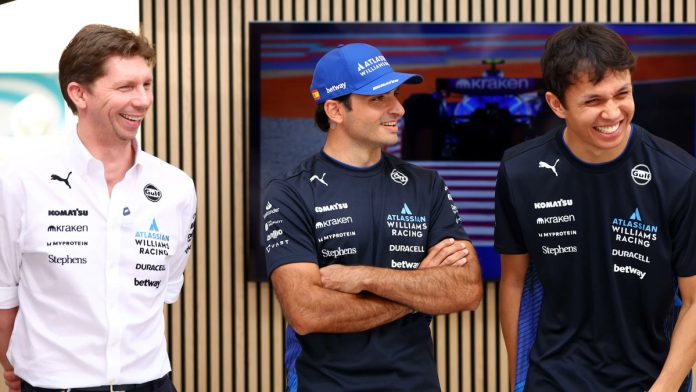
In the high-octane world of Formula 1, the stakes have never been higher as a fierce debate brews over the sport’s future. Williams team principal James Vowles has thrown down the gauntlet, challenging the very foundation of F1’s meritocracy amidst rising tensions over engine regulations and performance advantages. The spotlight is firmly on Mercedes, the powerhouse supplying engines to Williams, as rivals circle like sharks, eager to exploit what they perceive as a loophole in the upcoming 2026 regulations concerning compression ratios.
At the heart of the controversy lies a critical rule: a compression ratio limit of 16:1, which is measured at ambient temperature. However, whispers suggest that Mercedes has ingeniously manipulated this rule, allowing their engines to operate at a higher level when running hot. This revelation has ignited outrage among competitors such as Ferrari, Audi, Honda, and Red Bull Powertrains, who are now banding together to propose a crucial amendment that would see compression ratios measured at operating temperature instead.
The ramifications of this rule change could be monumental. If these four manufacturers can unite and gain enough support, they could potentially create a supermajority to enact immediate changes, provided they also secure backing from the FIA and Formula One Management. With the FIA remaining tight-lipped about its official stance, Mercedes finds itself in a precarious position, as the outcome of this brewing storm is largely out of their control.
Next week, all eyes will be on the F1 Commission meeting set to unfold in Bahrain, coinciding with the pre-season testing period. Vowles believes this situation transcends mere technicalities and speaks to a pivotal choice for the sport: does F1 cling to its pioneering spirit, or does it devolve into a Balance of Performance (BoP) series where technical excellence is stifled in favor of parity?
“We as a sport have to take care that this is not a BoP series,” Vowles declared passionately. He emphasized that F1 should reward the best engineering outcomes rather than punish them. While it’s understandable that other teams may feel frustrated for not matching Mercedes’ ingenuity, Vowles insists it’s vital for the sport to uphold its commitment to meritocracy.
In ongoing discussions with Mercedes’ team principal Toto Wolff and engine chief Hywel Thomas, Vowles has expressed confidence that Williams’ current power unit design complies fully with existing regulations. However, he raises a crucial question: what happens if the rules change? The implications could be disastrous, potentially sidelining several cars from the grid.
Vowles cautioned against hastily altering the compression testing procedures without considering the broader impact. “First of all, they have to come up with a regulation, and good luck with testing power units under the conditions you’re trying to run on track,” he said. He further warned that if a rule change renders some cars illegal, it could lead to a situation where eight cars might not participate, a scenario that would be catastrophic for the sport.
Meanwhile, the FIA has been proactive, engaging in discussions with power unit manufacturers and technical experts to explore how new procedures could be implemented effectively. Nikolas Tombazis, the FIA’s single-seater director, articulated the governing body’s desire to avoid controversy as the season approaches. “We are determined to make this a championship of competition between the best drivers, best engineers, the teams, but not a championship of rule interpretation,” he stated emphatically. This commitment to preserving the integrity of F1 reflects a broader understanding that the essence of the sport lies in engineering brilliance and driving skill, not merely navigating the complexities of regulations.
As the clock ticks down to the crucial F1 Commission meeting, the future of Formula 1 hangs in the balance. Will it remain a true meritocracy, or will it succumb to the pressures of conformity? The answer could redefine the sport for generations to come.