


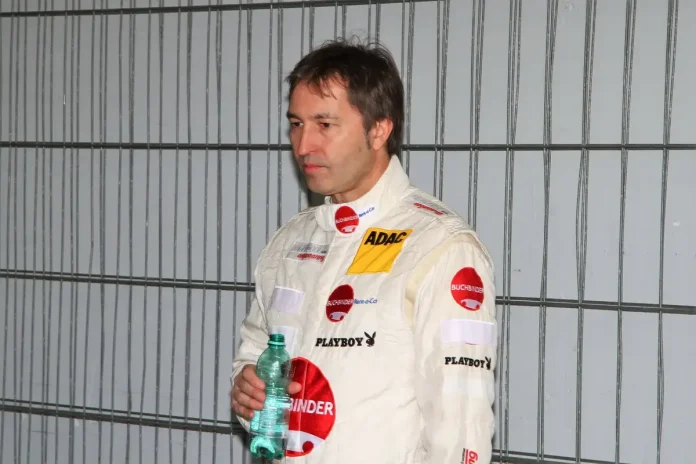
Heinz-Harald Frentzen, once a formidable force in Formula 1, has opened up about the disillusionment that shadowed his final season in 2003, revealing a gripping narrative of burnout and lost ambition. Frentzen candidly reflects on how he felt “overpaid” and unmotivated while racing for Sauber, a stark contrast to the glory days of his early career. After being unceremoniously dropped by Eddie Jordan in 2001, Frentzen’s journey through the sport became increasingly tumultuous, leading to a painful realization that his once-promising trajectory was spiraling downward.
Frentzen’s struggles began when he was let go by Jordan, prompting a desperate quest for stability that saw him racing for the beleaguered Prost and Arrows teams. These squads were in dire straits, and despite his willingness to race for free to support Prost, the German driver found himself without a paycheck. “When Eddie sacked me in 2001, I went to Prost GP for the rest of the season. But Alain [Prost] couldn’t pay me,” Frentzen recalled. His time with Arrows in 2002 was no better, as financial woes led to the team’s collapse mid-season, leaving him without compensation yet again.
His eventual signing with Sauber was perceived as a glimmer of hope, but the reality proved disheartening. Despite scoring 13 points and a remarkable return to the podium in the United States, Frentzen was plagued by frustration. The root of his discontent lay in his conflict with the team’s technical director, Willy Rampf, who dismissed the importance of driver feedback in car development. Frentzen, known for his deep understanding of vehicle mechanics, felt stifled. “Willy Rampf said to me, ‘You cannot touch any construction side of the car anymore… But you cannot touch caster, roll centres, anti-dive, anti-lift, you cannot touch the dampers’,” he explained, capturing the essence of his frustration.
The disconnection between Frentzen’s aspirations and Rampf’s rigid approach led him to a breaking point. “That’s where I completely lost the motivation,” he admitted. He felt like a mere driver, stripped of the intellectual engagement that once fueled his passion for racing. Instead of strategizing and optimizing the car’s performance, he was relegated to simply pressing the throttle. His situation became emblematic of a deeper issue within the sport, where experienced drivers sometimes find themselves at odds with the teams that employ them.
Frentzen’s decision to step away from F1 was not solely due to technical disagreements; it was also a response to the burnout that had quietly crept in. With a heavy heart, he recalled an encounter with Eddie Jordan at his final race in Suzuka, where Jordan attempted to coax him back for another season. “I couldn’t do it; today, we would call it burnout syndrome. In those days, that word didn’t exist. I was absolutely finished,” he confessed. The prospect of racing in the DTM series felt like a breath of fresh air, a departure from the relentless pressures of Formula 1.
Reflecting on his career, Frentzen expressed a sense of regret. He believed he could have achieved more, lamenting his inability to navigate the political landscape of the sport effectively. “I was blaming myself that I was not being politically strong enough when dealing with the situation with Eddie when he kicked me out,” he stated, revealing the internal struggles that accompanied his racing life. Despite his undeniable talent, he felt he fell short of being a complete racing driver, unable to rally support for his vision of car development.
Frentzen’s story serves as a poignant reminder of the pressures faced by professional athletes, where the line between success and burnout can be painfully thin. His candid admission that a racing driver must shoulder the blame for their performance—”As a racing driver, we learn quite quickly, you never blame the team or somebody else for your poor performance”—sheds light on the mental fortitude required in such a high-stakes environment. As fans and pundits continue to dissect the intricacies of Formula 1, Frentzen’s experiences resonate, echoing the struggles of many who have walked the tightrope of ambition and disillusionment in the unforgiving world of motorsport.