


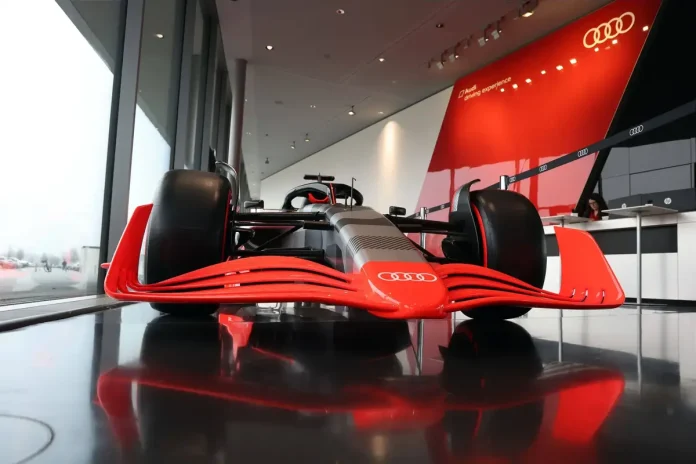
Audi’s foray into Formula 1 is on the brink of a monumental milestone as the automotive giant prepares to ignite its new hybrid power unit within its inaugural F1 chassis in the coming days. The clock is ticking down to a groundbreaking moment, with Sauber team boss Jonathan Wheatley confirming that the ambitious project remains firmly on schedule to achieve a fire-up before the holiday season.
Earlier this year, Wheatley outlined a bold vision for the Audi F1 engine to roar to life in December, and he remains optimistic that this timeline will be met. The transformation of Sauber into the official Audi F1 team marks the end of an era after 32 years, as the Swiss squad undergoes a complete overhaul following Audi’s full acquisition. This transition signifies not just a change in name but a significant leap forward into a new era of competitiveness, manufacturing both chassis and power units in alignment with the upcoming 2026 regulations.
Wheatley emphasized the unprecedented nature of this endeavor in the world of F1, stating, “We’re bringing together a brand new power unit with a chassis for the first time and we’re firing it up before Christmas. I can’t remember ever doing that.” This early engine fire-up underscores the urgency and ambition behind Audi’s entrance into Formula 1, as teams across the grid adjust their winter testing schedules to accommodate the accelerated timeline.
The challenge ahead is daunting, with Wheatley acknowledging the immense workload that lies between now and the end of the year. He noted the pressure of running both the existing Sauber team and the transition to Audi, highlighting the substantial expectations placed on every department. “Every sign in the factory, every single thing, has to be different,” he asserted, indicating a fundamental shift in the team’s identity and operational ethos.
Despite Audi’s ambitious plans, they are racing against time and competition. Honda has already stolen a march by releasing an audio clip of its own 2026 1.6-litre V6 hybrid engine, providing fans with an early glimpse of the sound of the future. Speculation is rife that Audi could hit the track for a filming day on January 9 at Barcelona’s Circuit de Catalunya, a move that would put them ahead of the official testing window set for late January. However, Audi has been tight-lipped about confirming this date, preferring to keep their early track activities under wraps from the public eye.
Wheatley believes that the upcoming filming day and subsequent pre-season tests will only be the beginning of a long journey for Audi. He warned that determining the true performance capabilities of the team may take several races into the season, stating, “You’re not going to know until Melbourne. Probably need to be four races into the season before we can actually build a picture of our performance.”
As Wheatley navigates the transition from a storied career at Red Bull to leading Audi, he is acutely aware of the challenges that lie ahead. He candidly acknowledged the historical lack of capital investment in Sauber over the past 15 years, which has placed the team at a disadvantage. However, with a substantial increase in personnel—from around 300 to nearly 700—and the establishment of a new facility in the UK, the groundwork is being laid for a future filled with promise.
The new technology center at Bicester Motion is a strategic move aimed at enhancing the team’s technical capabilities and attracting elite engineering talent from the UK, home to seven of the ten F1 teams. While Wheatley admitted that the Bicester facility has yet to make a significant impact on their preparations, he remains confident that it will play a crucial role as they ramp up their operations leading into the 2026 season.
With high ambitions and substantial investments in place, Audi’s entry into F1 is poised to shake up the established order. As fans eagerly await the sound of the new engine and the unveiling of the Audi F1 team’s capabilities, the stage is set for a thrilling new chapter in motorsport history.