


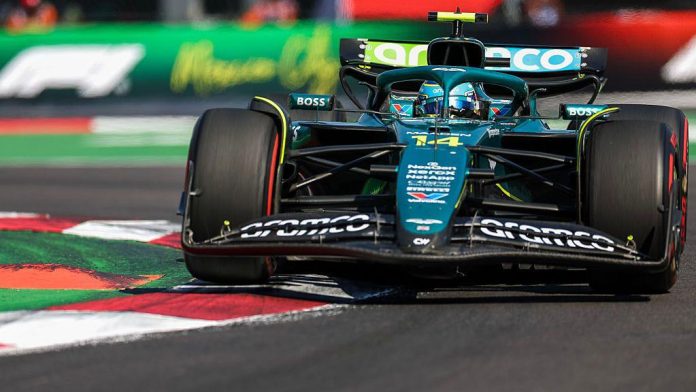
Aston Martin’s 2023 Formula 1 campaign turned out to be a sobering affair, far from the high hopes the team had before the engines roared to life. After securing fifth place in the constructors’ championship for two consecutive years, the Silverstone-based team found itself regressing to seventh, trailing behind an invigorated Williams and even the formidable Racing Bulls. This season starkly illustrated a transitional phase for Aston Martin, with a conscious decision to divert resources towards future ambitions, compromising immediate performance on the track.
Fernando Alonso, the seasoned two-time world champion, faced one of the toughest seasons since joining Aston Martin in 2023, finishing a disappointing 10th in the drivers’ standings with a mere 56 points. His campaign was marred by an unfortunate series of events, including five retirements that significantly impacted his ability to score points. Technical failures at critical moments only added to his woes, with brake issues in China and Mexico, a power unit malfunction in Monaco, and suspension damage in Italy testing the limits of his patience. A crash during the season opener in Australia further compounded his frustrations. Although Alonso showcased moments of undeniable speed, particularly with a standout fifth-place finish in Hungary, these were fleeting glimpses of potential rather than a consistent threat to the podium.
Meanwhile, teammate Lance Stroll’s performance was equally underwhelming. He struggled to keep pace with Alonso, consistently being outqualified and finishing the season a staggering six places and 25 points behind the veteran. The disparity between their performances underscored broader issues within the team, revealing a lack of consistency and pace from the AMR25 that both drivers could not unlock.
Despite the disheartening results, the future looks promising for Aston Martin as they set their sights on the 2025 season. The appointment of Adrian Newey is seen as a pivotal moment in their strategy, marking a significant shift in the team’s direction. Initially brought on as managing technical partner, Newey’s elevation to team principal is expected to infuse the organization with renewed ambition and technical expertise as they prepare for a major overhaul in 2026.
The partnership with Honda is another cornerstone of Aston Martin’s ambitious plans. Transitioning from customer Mercedes power units to a direct collaboration with Honda opens the door for a more cohesive development process. This alignment with Honda’s sustainability goals and the introduction of new power unit regulations, featuring active aerodynamics and advanced electrical systems, could provide the technical edge Aston Martin desperately needs.
Moreover, the team’s cutting-edge Technology Campus in Silverstone is reaching full operational capacity, complete with a new wind tunnel and simulator. For the first time since 2008, Aston Martin will develop its own transmission and rear suspension, marking a bold transition from customer to works team status. As the new regulations set the stage for a level playing field, Aston Martin’s resources and ambitions position them favorably for a significant leap forward in performance.
With the unveiling of the AMR26 scheduled for February 9, the upcoming season promises to be a crucial test of whether Aston Martin’s strategic pivots will bear fruit. With Newey’s technical acumen, Honda’s engineering capabilities, and Alonso’s championship experience, the ingredients for a formidable challenge are in place. The burning question remains: can this ambitious project translate into a genuine title contender in Formula 1’s evolving landscape?