


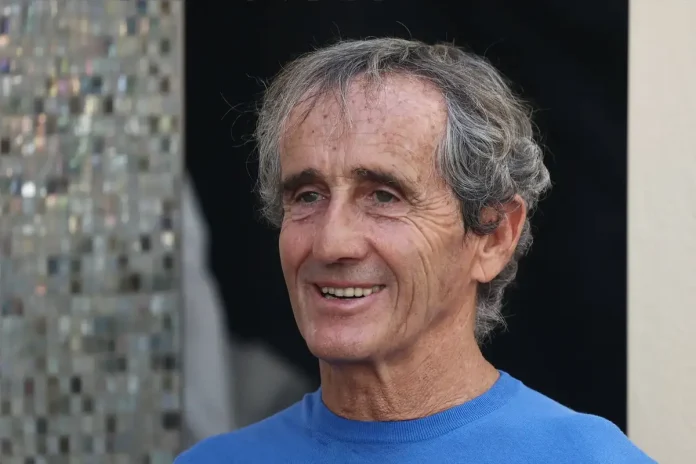
Alain Prost, the legendary four-time Formula 1 champion, has issued a stark warning about Renault’s future in the sport. He suggests that the French auto giant’s departure from the F1 engine manufacturing scene may not just be temporary—it could be a long-term exit, possibly permanent. As the sport evolves, Prost highlights the daunting challenges Renault would face in attempting a comeback due to the stringent regulations of the next generation of Formula 1.
Renault’s storied history in Formula 1 dates back to 1977, when it first introduced turbocharged engines to the championship. Over the decades, the brand has played a pivotal role in the evolution of the sport, supplying engines to iconic teams like Williams, Lotus, Red Bull, and McLaren, which ultimately led to the establishment of the official Alpine project. However, the tide has turned for Renault, as recent underperformance paired with skyrocketing costs prompted Alpine to switch to Mercedes engines starting in 2026. This decision marks the end of Renault’s factory engine program based in Viry-Châtillon, which will now pivot towards Alpine’s Hypercar project in the World Endurance Championship (WEC).
Prost’s connection to Renault runs deep, both historically and emotionally. While he understands the financial rationale behind the decision—especially considering the higher operational costs of a French-based team compared to those in the UK—he cannot shake the profound sadness that accompanies it. “It’s a shame [the exit from F1]. I understand the decision from a financial point of view. Especially when managing a team based in France. The costs are higher than in countries like England,” Prost lamented.
He reflects on his longstanding relationship with the brand, saying, “I was involved with Renault when it was still a racing school and then in Formula Renault—this was about 50 years ago. So, I always keep an eye on them. I still work with them today.”
Prost’s analysis paints a grim picture for Renault’s potential return. He emphasizes the current regulatory framework in Formula 1, suggesting that any future comeback would be significantly more difficult than in previous instances of team withdrawal. “This chapter of Formula 1’s history may be closed for an indefinite period,” he asserts.
Renault’s exit is not just a corporate decision; it signifies the end of an era. “I’m very sad because it feels like a long history is fading away without anyone talking about it,” Prost expressed. As he reflects on the rich legacy that Renault has contributed to motorsport, he concludes with a heavy heart, “It’s going to be very difficult for them to come back. Maybe in a long time, but it’s too complicated. Perhaps in another way.”
Prost’s insights serve as a poignant reminder of the shifting landscape of Formula 1, where the financial realities of competing at the highest level can overshadow the emotional ties that once bonded teams and drivers to the sport’s illustrious history.