


Denny Hamlin, one of NASCAR’s most outspoken drivers, ignited a firestorm of discussion back in August when he boldly declared, “The field is running the same speed.” This statement resonated with many in the racing community who have been quietly voicing their concerns about the limitations of NASCAR’s Gen-7 car since its introduction. Hamlin has not held back on his criticism, asserting that the push for parity has stifled the essence of racing—craft, strategy, and the exhilarating overtakes that fans crave.
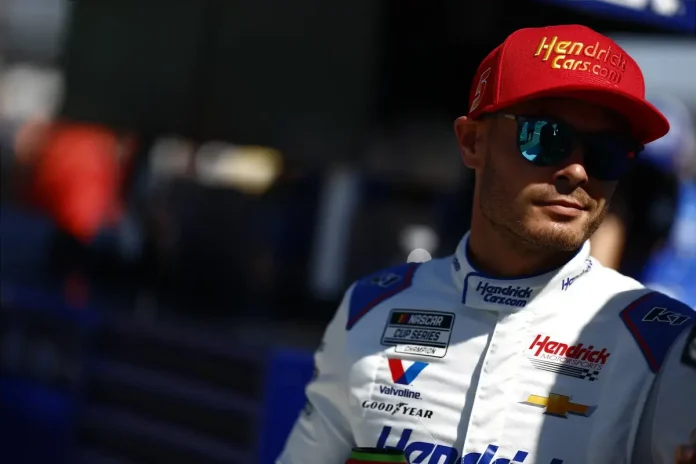
Now, Kyle Larson, a driver renowned for his versatility and skill, has joined the chorus of dissent. While he stops short of launching a full-scale attack on the Gen-7, his recent observations strike a chord with those who share his sentiments. Larson acknowledges the advantages of increased parity—more winners and a more competitive field—but he also raises a critical question: has this emphasis on equality compromised the quality of racing itself?
Larson expressed his thoughts candidly: “I think we all just had the same car now. Now the sport’s cool because of more winners than we ever have before and the parity is much better. But, at the same point it’s like, it’s made the racing a little bit worse. I feel like it’s harder to pass.” His words encapsulate a pivotal dilemma facing NASCAR: while the statistics might paint a picture of health—14 different winners across seven organizations in 2025—there’s a deeper issue at play.
The Gen-7 car was engineered to level the playing field, making races less about the machine and more about the driver. While this has resulted in thrilling unpredictability in victory lane, it has also led to a troubling trend where track position trumps speed. Clean air has become the ultimate prize, while dirty air acts as a nearly insurmountable barrier, particularly on short tracks where passing used to be a hallmark of the sport. The April race at Bristol serves as a prime example; despite Larson’s dominance—leading 411 laps and sweeping both stages—the event left fans divided. Was it impressive? Absolutely. But entertaining? That’s where opinions diverged, as cars struggled to advance even with superior speed.
Hamlin’s critique during the Richmond weekend was blunt: “The field is just now running the same speed, and at a track where you have to have three to three and a half tenths of speed to overtake the car in front of you, that means that the first-place fastest car is going to struggle to pass the 25th if he just gets put behind him.” This sentiment highlights the growing frustration not just among drivers but also among fans who yearn for the thrilling battles that define NASCAR.
Despite the challenges, Larson remains optimistic about his team’s performance. “It’s just a different race car and a different style of racing we have to adapt to,” he stated. His team, Hendrick Motorsports, has indeed been the benchmark in the Cup Series, racking up an impressive 40 wins since the Gen-7’s debut. Larson’s championship in 2025 is a testament to Hendrick’s ability to navigate the new landscape of NASCAR, but he acknowledges that the competition has never been fiercer.
As Team Penske has reigned supreme in recent years, securing three consecutive titles from 2022 to 2024, the pressure has intensified on all teams. Joe Gibbs Racing, with drivers like Hamlin and Christopher Bell, continues to assert its presence, especially in 2025 with Hamlin leading the series in wins.
Interestingly, the very shift that was meant to create a more equitable racing environment has inadvertently concentrated power among a select few teams. Hendrick Motorsports, Joe Gibbs Racing, and Team Penske—the sport’s elite trio—have the resources and infrastructure to consistently outpace the competition. As Michael McDowell quipped, the only way to bridge the gap is to “steal their people.” In this era, adaptation is no longer optional, and even the top teams find themselves in an intense struggle to maintain their edge.
The landscape of NASCAR is undeniably changing, and as Larson’s insights reveal, the balance between parity and the thrill of racing is a delicate one. As fans and drivers alike navigate this new reality, one thing is clear: the conversation about the future of NASCAR is just beginning.