


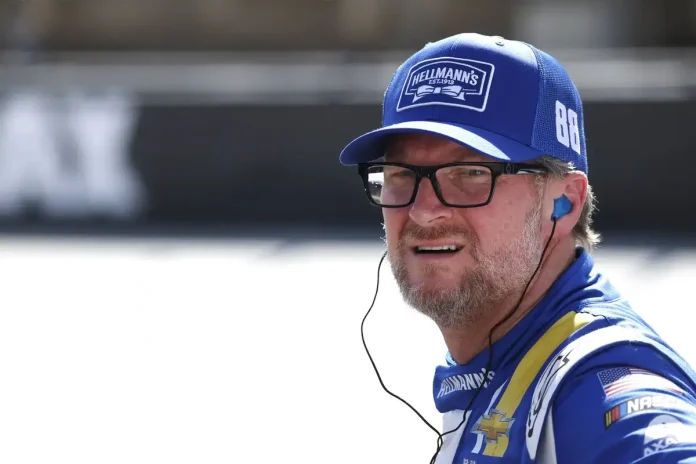
Dale Earnhardt Jr. is not holding back. The NASCAR icon has unleashed a fierce critique of the organization’s leadership decisions, which he believes have led to significant missteps. With the return of marquee racing to the historic Bowman Gray Stadium, Junior is asking the tough questions about why it took NASCAR so long to recognize the value of this iconic venue.
Reflecting on NASCAR’s decision to shift its All-Star race to the LA Coliseum in 2025 after a 53-year absence from Bowman Gray, Junior sees this as a glaring oversight in judgment. For him, the legendary half-mile track, home to racing legends like Lee Petty and Richard Petty, should have always been the focal point. Speaking candidly on his podcast, Dale Jr. Download, he expressed his bewilderment at NASCAR’s tendency to experiment with less meaningful venues instead of sticking with what resonates with fans.
“I love the idea on paper, but we should have never, like that’s the part about NASCAR that’s frustrating for me is that we eventually get to where we’re supposed to be, but like we try a bunch of things,” he said, revealing his frustration over NASCAR’s experimental approach. The return to Bowman Gray, affectionately nicknamed the Madhouse, marked a significant moment in racing history, with a staggering 30.8 million viewers tuning in, far surpassing the 1.51 million who watched the previous year’s event in Los Angeles. This dramatic shift proves that the heart of NASCAR’s fan base lies in its roots.
Junior’s comments underline a broader frustration within the sport: why does it take so long for NASCAR to recognize the obvious? “We eventually like, oh, s—this was the answer. It was Bowman Gray, ’cause like literally … is …part of the original seasoning that created NASCAR…. Like it’s like Wrigley Field… what were we doing out in LA at this coliseum that we had no personal connection to?” he added, emphasizing the disconnection between NASCAR’s decisions and the passionate fan base that craves authenticity.
Ben Kennedy, NASCAR’s Senior Vice President of Racing Development and Strategy, hinted at the possibility of more races at Bowman Gray, which piqued Junior’s interest. However, his excitement is tempered by frustration over NASCAR’s past decisions. “But we eventually end up where we belong, you know, and where we should be,” he admitted, acknowledging the eventual return to historical venues but lamenting the detours taken along the way.
Adding to the mix is Junior’s passionate involvement in the revival of North Wilkesboro Speedway. He played a pivotal role in reigniting interest in the historic track by having it digitally recreated for iRacing, paving the way for its return to the NASCAR schedule by 2026. However, despite his contributions, his name surfaced in text messages related to NASCAR’s anti-trust lawsuit, raising eyebrows and suggesting a disconnect between his advocacy for the sport’s heritage and the organization’s recent actions.
“North Wilkesboro came back because of Marcus Smith … NASCAR, you know, they didn’t play any role,” he stated, making it clear that the resurgence of the speedway was the result of grassroots efforts rather than NASCAR’s initiatives. This revelation came as a disappointment to many, highlighting a perceived lack of leadership from NASCAR in preserving the sport’s legacy.
As the dust settles from the lawsuit that entangled teams and individuals with no direct involvement, Junior’s reflections reveal a desire for change. While NASCAR has made concessions like permanent charters that teams have long sought, Junior emphasizes that regaining the trust of passionate fans will require serious effort from leadership. The road ahead is fraught with challenges, but the message from Dale Earnhardt Jr. is clear: NASCAR must recognize its roots and listen to the voices that have shaped the sport. The future of NASCAR hinges on its ability to connect with its history and its fans.