


Formula 1 is on the brink of a revolutionary transformation as teams take to the track for the post-season test in Abu Dhabi, armed with a tantalizing glimpse into the future of racing. This year, the stakes are higher than ever, with a unique nine-hour window for teams to collect crucial data on Pirelli’s innovative 2026 tyres, paving the way for a new era of high-speed competition.
Mule cars, specially designed ground-effect machines, are being utilized to mimic the significantly reduced downforce that will characterize the 2026 regulations. Teams are strategically adjusting their setups, opting for Monza-style wing configurations and elevating ride heights to minimize aerodynamic loading. This experimental phase is not just about speed; it’s about redefining the fundamentals of race engineering.
One of the most electrifying developments this year is the FIA’s green light for select prototype components, including cutting-edge front-wing concepts. As the DRS system is set to vanish in 2026, the spotlight shifts to active aerodynamics, which will become a game-changer in how teams approach race strategies. For the first time, drivers will have the power to manipulate both front and rear wings during straights, transforming the front wing into a dynamic, active mechanism.
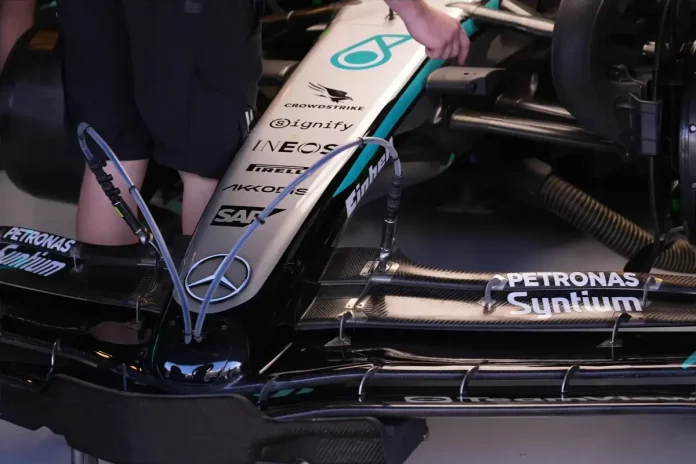
Mercedes has stepped up to showcase its vision for this new approach at the Yas Marina Circuit. With Andrea Kimi Antonelli behind the wheel of the W16, the team revealed its Straight Line Mode system, which is engineered to slash front-wing drag on straightaways. Though still in its infancy, the system features visible tubing connecting the nose to actuators on the upper wing elements. This early implementation hints at a more refined version that will emerge by 2026, highlighting Mercedes’ commitment to innovation.
Ferrari is not far behind, having tested similar active aero solutions during a private session. The Scuderia is currently ramping up its mileage with this system in Abu Dhabi, eager to glean insights that could give them an edge in the upcoming seasons.
These pioneering aerodynamic advancements serve a dual purpose. Besides enhancing performance, they are critical for Pirelli as they benchmark tyre behavior under varied conditions. By juxtaposing cars equipped with active front aerodynamics against those without, engineers can meticulously analyze load dynamics and validate the performance targets for the following year’s tyres.
Pirelli’s Mario Isola emphasized the significance of this testing phase. “Talking about the front Straight Line Mode, the FIA gave the opportunity to the teams to develop a system that replicated this on the front wing. In that case, obviously, they don’t have to comply with the speed limit restriction.” This flexibility allows teams to push the boundaries, with mule cars typically restricted to around 300 km/h on straight sections to safeguard the tyres.
Isola added, “It’s also useful for us because you can compare a car that is running without the system with a car that is running with the system. When we did the first test with Ferrari with the system, it was really useful to understand and to compare this test with all the other tests, in terms of load and what we achieved, to understand and to make the other tests more representative.”
In addition to aerodynamic innovations, teams are also seizing the opportunity to experiment with prototype wheel rims, blending current designs with those slated for 2026. “In some cases, teams ask for testing rims similar to the ones they are going to use next year, when they obviously have more freedom in designing the rim. And they have been authorized by the FIA to do a certain number of runs with the new rims,” Isola explained.
As this thrilling chapter in Formula 1 unfolds, fans and experts alike are left buzzing with anticipation for the seismic shifts that lie ahead in 2026. With teams like Mercedes and Ferrari leading the charge, the future of motorsport is not just on the horizon; it’s racing toward us at breakneck speed.