


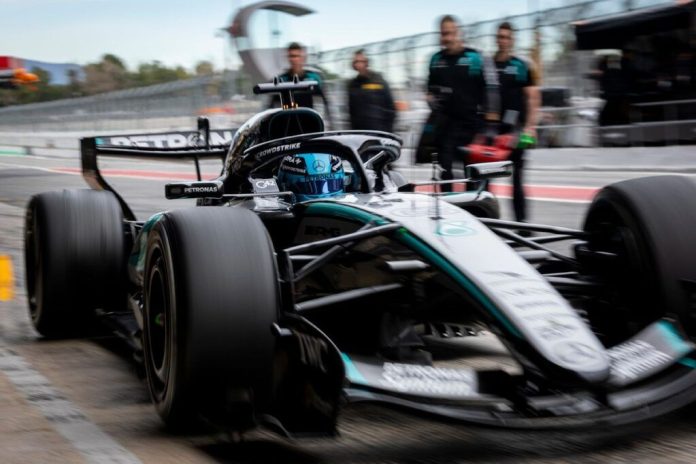
As the curtain rises on the 2026 Formula 1 season, whispers of uncertainty and optimism swirl around the Mercedes team, stirring intrigue among fans and analysts alike. The initial glimpses into their performance during testing have sent shockwaves through the paddock, leaving many to ponder whether Mercedes can shake off the shadows of past struggles and reclaim its dominant form.
In the lead-up to the Barcelona test, speculation ran rampant about Mercedes being the early favorite. However, the reality was far more ambiguous, with many unsure of what to expect once the engines roared to life. Now, with the W17 hitting the track, the feedback emerging from the team paints an intriguing picture. George Russell, in a moment of levity, humorously echoed team principal Toto Wolff in declaring that the new car is “not a turd.” This light-hearted remark, while amusing, underscores a more serious sentiment: early indicators suggest that Mercedes may have sidestepped the issues that plagued them during the turbulent ground-effect era.
What truly excites Mercedes is not merely the reliability of the car or its performance on the track, but rather how the vehicle feels and aligns with the data they’ve meticulously gathered. In stark contrast to the past few seasons, when the team often found themselves mired in uncertainty, the early signs from testing have been positive. Russell highlighted that Mercedes is confident there are no “crazy unknowns or unforeseen things” lurking in the shadows, an allusion to the porpoising issues that haunted them at the start of the ground-effect era.
The team left Barcelona buoyed by a sense of clarity. The car’s performance aligned closely with simulations, and even Kimi Antonelli noted it felt “quite a bit better” than what was predicted in the virtual realm. Russell asserted that the correlation between real-world performance and simulation data is the best the team has experienced since their last championship-winning season in 2021. “The car reacted as we anticipated,” he stated, adding that they are “ticking the boxes of everything that we want to tick.”
However, it’s not all sunshine and rainbows. While Mercedes is reveling in the positive early reads, Wolff remains a pragmatist, warning against overconfidence. He stressed that the team must remain cautious, acknowledging that there’s still much to learn as they analyze the performance of their rivals. “The most clever guys in the car and on the engineering side are gonna win,” he said, hinting at the fierce competition that lies ahead.
Despite their optimism, the team remains cautious, aware of the pitfalls of misplaced expectations. Wolff’s tempered enthusiasm reflects a “glass-half-empty” approach, as he reminded everyone that the true performance picture is still shrouded in uncertainty. Russell echoed this sentiment, remarking that it’s “way too early” to predict whether the car is a championship contender.
The testing in Barcelona, however, exceeded all expectations in terms of reliability, allowing Mercedes to wrap up their sessions early and dive into data analysis. Hywel Thomas, who oversees the Mercedes engine program, hinted at even greater potential, stating, “we weren’t running, but we managed to walk” during the test. This signifies that the real speed could be unleashed in upcoming sessions, particularly in Bahrain, where teams will push to refine their setups and strategies.
While other teams displayed impressive reliability, Mercedes’ performance was noteworthy. Technical director James Allison remarked on the surprising level of reliability shown across the board, contrasting it with the chaotic scenes of past seasons. This sets the stage for an intense battle, as teams like Mercedes, Ferrari, and Red Bull appear to be the best prepared for the challenges ahead.
Russell acknowledged that as the season unfolds, drivers will need to adapt to new techniques for managing energy, particularly with the increased demands of the 2026 regulations. The advantage gained from accumulating more laps during testing could prove pivotal, as teams refine their strategies and navigate the complexities of the new power units.
Yet, the road ahead remains fraught with uncertainty. Russell emphasized that while the test was promising, there’s still substantial room for improvement. “It’s so challenging to say,” he acknowledged, recognizing the razor-thin margins that separate the leading teams. As the new season looms, all eyes will be on Mercedes to see if they can transform their cautious optimism into a formidable championship challenge. The clock is ticking, and the stage is set for a thrilling season of Formula 1 racing that promises to be anything but predictable.