


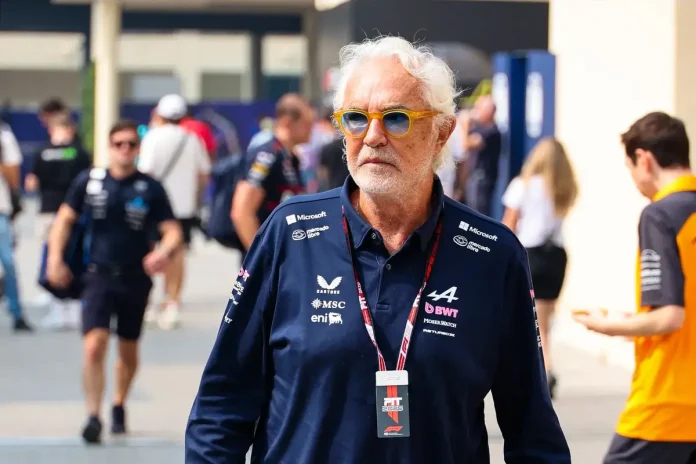
Flavio Briatore, the renowned former team principal behind Formula 1 icon Fernando Alonso, has shed light on the monumental significance of Alonso’s groundbreaking 2005 world championship victory. This wasn’t just a personal triumph for the two-time world champion; it was a pivotal moment that transformed the landscape of motorsport in Spain and beyond.
Alonso, who clinched back-to-back titles in 2005 and 2006 with Renault, famously dethroned the legendary seven-time champion Michael Schumacher in a dramatic fashion. Now, after an extraordinary two-decade career, Alonso stands as the driver with the most Grand Prix appearances in F1 history, continuing to defy age at 44. His relentless pursuit of excellence with Aston Martin has fans eagerly anticipating his next move as he aims to reclaim glory on the podium.
Reflecting on the impact of 2005, Briatore takes us back to a time when Alonso, then the youngest champion in F1 history, was thrust into the spotlight following a season where he dominated with seven victories. “He replaced a world champion and many criticized him for being young and inexperienced, but I believed in him,” Briatore stated in a recent DAZN documentary titled Bravissimo. “I was sure he was special. Over time you realize that he wasn’t just special; he was something more than that.”
Briatore passionately emphasizes that 2005 was not just about winning a championship; it marked the dawn of Formula 1’s popularity surge in Spain. “In 2005 we not only won a world championship, we also introduced Formula 1 to Spain. It was the moment when everyone truly got to know Fernando Alonso. Not just because he won the world championship, but because of how he won it; we did it with authority.”
As fans ponder the future, questions loom over Alonso’s potential for a third world title. While the dream may be dimming, the possibility of a 33rd career victory remains tantalizingly within reach. Despite a dry spell since his win at the 2013 Spanish Grand Prix, Alonso’s contract with Aston Martin runs until the end of next season, with hints of an extension if the team’s performance improves. He has made it clear: if Aston Martin can deliver a competitive car by 2026, he might consider retirement, but if results fall short, he could continue racing.
Alonso’s extraordinary talent remains evident, as he consistently outperformed his younger teammate Lance Stroll, out-qualifying him in all 24 races of 2025. The question now is whether this F1 veteran can harness his skills to achieve new heights and add to his already legendary status in the sport. The world watches with bated breath, hoping for one more spectacular chapter in the saga of Fernando Alonso.