


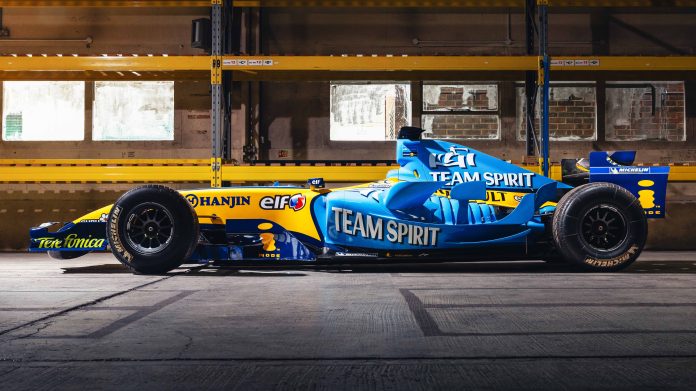
In a dramatic farewell to the high-octane world of Formula One, Renault’s storied history in the sport is highlighted by a series of unforgettable moments that have shaped both the brand and the championship. From its groundbreaking debut to its eventual exit as a constructor, Renault has left an indelible mark on F1, showcasing both triumphs and tribulations.
The saga began at the 1977 British Grand Prix, where Renault unveiled its revolutionary RS01, the first turbocharged car in F1 history. This daring debut was not without its challenges. Despite Jean-Pierre Jabouille’s valiant efforts, which saw him qualify 21st in a fiercely competitive 36-car field, mechanical failures plagued the car. The nickname ‘yellow teapot’ was earned for the frequent smoke that billowed from its engine, signaling the struggles ahead.
Fast forward to 1979, and a turning point arrived when Jabouille clinched Renault’s first victory at the French Grand Prix in Dijon-Prenois. This was no ordinary win, as he overtook the legendary Gilles Villeneuve, marking a historic milestone for both Renault and Jabouille. The race is often remembered for the exhilarating battle between Villeneuve and Renault’s Rene Arnoux, which has entered the annals of F1 lore.
By the 1980s, Renault’s fortunes continued to rise with Alain Prost behind the wheel of the RE40. The Frenchman secured multiple victories, but heartbreak struck as he narrowly missed the world title in 1983, losing to Nelson Piquet by a mere two points after suffering multiple retirements. The following years saw Renault supplying engines to other teams, leading to a sensational win by Ayrton Senna in the 1985 Portuguese Grand Prix, a feat that reignited the glory of the legendary Lotus brand.
Renault’s engine prowess was undeniable, as they returned to F1 as an engine supplier for Williams in 1989. The partnership proved fruitful, with Nigel Mansell and Alain Prost driving Renault-powered cars to championship glory in the early 1990s. Mansell’s dominance reached its peak with a title-winning season in 1992, while Prost followed suit in 1993, solidifying Renault’s status within the sport.
However, the tragedy struck in 1994 when Ayrton Senna’s untimely death at Imola cast a shadow over the sport. Damon Hill, who succeeded Senna at Williams, faced a dramatic title showdown with Michael Schumacher but fell short amidst controversy, leaving Renault to grapple with the emotional fallout.
The mid-90s saw Renault transitioning away from the spotlight as they exited F1 as a constructor in 1997, opting to focus on their engine supply business, which continued under various branding until 2000. The turn of the millennium marked a revival as Renault purchased the Benetton team and re-entered F1 as a constructor, hoping to reclaim their former glory.
The arrival of Fernando Alonso brought fresh hope, and by 2005, Renault was back at the top with Alonso becoming the youngest world champion. The following year saw another showdown between Alonso and Schumacher, culminating in a thrilling title battle that Renault narrowly won. This era was marked by technological innovations and fierce competition, setting the stage for one of F1’s most celebrated rivalries.
However, the tides began to turn in the late 2000s, with the infamous Crashgate scandal at the 2008 Singapore Grand Prix tarnishing Renault’s reputation. The orchestrated crash of Nelson Piquet Jr. led to a controversial victory for Alonso but resulted in a scandal that would haunt the team for years.
As F1 transitioned into the hybrid era in 2014, Renault faced new challenges, struggling against dominant rivals. Their partnership with Red Bull yielded success, yet the team found itself in a precarious position, navigating fierce competition and shifting dynamics within the paddock.
After a tumultuous period, Renault re-entered the fray as a constructor in 2016, setting ambitious goals of podium finishes and championship contention. However, aspirations often clashed with reality, as the team struggled to find consistent performance.
The highlight of recent years came in 2021 when Esteban Ocon delivered a remarkable victory at the Hungarian Grand Prix, marking a high point amid ongoing struggles. Yet, as the clock ticks toward 2026, Renault’s legacy is set to change dramatically with a switch to Mercedes power, signaling the end of an era that has captivated fans for decades.
As Renault bids adieu to its F1 roots, the echoes of its triumphs and challenges resonate throughout the sport. The journey is one of innovation, competition, and heart-stopping drama, ensuring that Renault’s legacy will be remembered long after they leave the grid.