


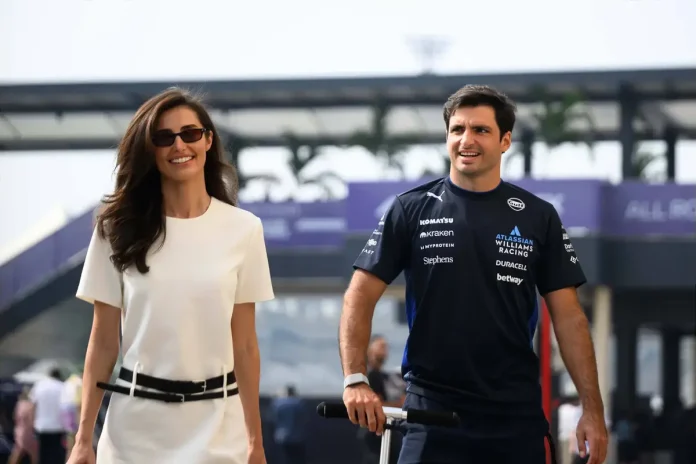
In a world where the stakes are relentlessly high and the competition is cutthroat, Carlos Sainz has emerged as a voice of reason amidst the chaos of Formula 1. The seasoned driver, now with Williams, is shedding light on a critical issue that has long been overlooked—the grueling adjustment period faced by drivers transitioning to new teams. As a veteran of the sport with experience at Toro Rosso, Renault, McLaren, Ferrari, and now Williams, Sainz’s perspective is not just anecdotal; it’s backed by hard evidence from the grid.
The landscape of F1 has witnessed a flurry of driver changes leading into the 2025 season, and Sainz believes this upheaval has validated his long-standing assertions about the time it takes to truly adapt to a new team environment. With drivers like Liam Lawson struggling to find their footing in the high-pressure atmosphere of Red Bull and Yuki Tsunoda unable to find his rhythm, Sainz’s claims gain further credence. The most glaring example of this struggle, however, is the seven-time world champion Lewis Hamilton, who has faced a harrowing debut season with Ferrari after Sainz’s departure. Hamilton’s performance has been a topic of heated discussion, showcasing just how challenging the transition can be, even for the best in the business.
Sainz articulated his thoughts candidly, stating, “I’m a driver that, fortunately or unfortunately, has had to change teams quite often. I’ve always been very vocal about how long it takes a driver to adapt to a new team, to extract the last couple of tenths out of the car, and to feel at one with it, but also with your engineers, with the rest of the team.” His remarks reflect the frustration of a driver who knows firsthand the uphill battle that comes with adapting to new machinery and team dynamics.
For years, Sainz felt his message fell on deaf ears, as many dismissed his insights with the notion that all F1 drivers should be able to adapt seamlessly. “I feel like no one really bought that a few years ago when I was saying it,” he lamented. The recent struggles of his peers have, however, provided a real-world testament to the challenges he has consistently highlighted.
The beginning of Sainz’s journey with Williams was rocky, as he faced stiff competition from teammate Alex Albon. By the summer break, Sainz had racked up only 16 points while Albon showcased his prowess with 54. Yet, the latter half of the season revealed a dramatic turnaround. Sainz, showcasing his resilience and skill, outscored Albon 48 to 3, clinching two podiums and a top-three finish in a sprint race. His remarkable comeback underscores the importance of perseverance, adaptation, and time.
As Sainz reflects on his evolution within the sport, he emphasizes the competitive nature of F1: “The reality is, with the talent and the speed there is nowadays in F1, when you’re up against Alex Albon in a Williams, Charles Leclerc in a Ferrari, or Max Verstappen in a Red Bull, they know the car by heart.” This observation highlights the steep learning curve that newcomers face. “In the best case, you can match that and maybe improve it a bit, but in most cases when you’re new to a team, you’re going to be a step behind in every free practice session, in every qualifying session, and in every grand prix.”
Sainz’s words resonate loudly in the fast-paced world of Formula 1, where the margin for error is razor-thin and the pressure is relentless. His candid assessment not only sheds light on the struggles of transitioning drivers but also serves as a powerful reminder that greatness often requires time and patience. As the 2025 season unfolds, fans and teams alike would do well to heed Sainz’s insights on the complexities of adaptation in the high-octane realm of motorsport.