


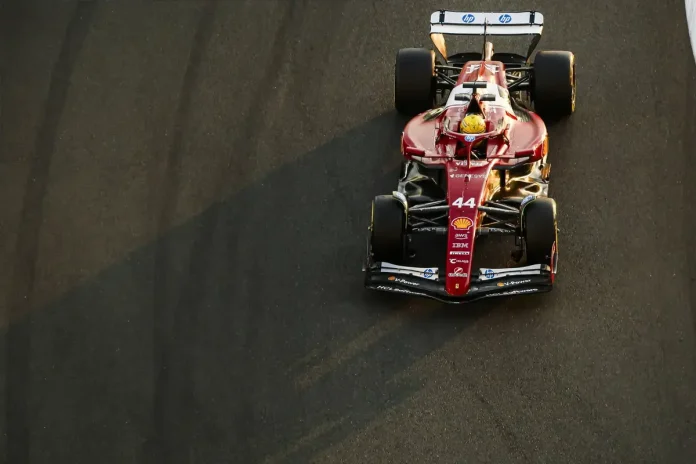
Ferrari’s decision to bring in the legendary Lewis Hamilton has sent shockwaves through the Formula 1 world, but the reality of the situation has turned out to be far more challenging than anticipated. Team principal Fred Vasseur has finally shed light on the intricacies of Hamilton’s struggles during his inaugural season with the Scuderia, a season that has proven to be a monumental challenge for the seven-time world champion. After ending his illustrious tenure at Mercedes, Hamilton has faced an uphill battle, concluding the year without a single podium finish for the first time in his illustrious career.
Vasseur’s candid remarks underscore a crucial point: both Ferrari and Hamilton must shoulder the responsibility to unlock the car’s full potential. The pressure is palpable as Vasseur emphasizes a collective mindset shift. “I think it has to come from everywhere,” he stated, addressing the media. “I think that the mindset of the team and the mindset of the driver has to be ‘let’s try to do a better job everywhere.’” His words resonate deeply within the corridors of Maranello, where the urgency for improvement is more pronounced than ever.
The stark reality for Hamilton is that the difficulties he has faced are not solely a result of the car’s performance but also tied to adapting to new variables in his racing environment. Vasseur points out that the F1 landscape is littered with the minutiae that can cost precious milliseconds on the track. “He has to improve perhaps on how he gets the best from the car that he has,” Vasseur remarked, hinting at the need for Hamilton to recalibrate his approach and strategies to extract every ounce of performance from a car that is still finding its footing.
It’s not just a matter of a single component holding back progress; rather, it’s a web of interconnected issues that need addressing. Vasseur elaborates on this by mentioning the transition in brake suppliers, a significant change for Hamilton after two decades of familiarity. “I know what you have in mind, the brakes, for example. He spent 20 years with one supplier, they changed this season,” he explained. This change, combined with a host of other factors, has left Hamilton grappling with a performance gap that is both frustrating and challenging to overcome.
The crux of the matter lies in the understanding that the difference between success and mediocrity can often be a mere fraction of a second. Vasseur’s insistence that there are numerous areas where Hamilton is losing time speaks to the complexity of F1 racing. “Quite often, it’s that you have 10 topics where you are three hundredths of a second slower. One after one, we have to tackle each point,” he concluded, highlighting the meticulous work that lies ahead.
As the team moves into the new season, all eyes will be on Ferrari and Hamilton to see if they can transform these insights into tangible results. With the right adjustments and a unified approach, there is hope that the iconic driver can reclaim his status among the sport’s elite, but it will require relentless effort from both the team and the driver. The countdown to the new season has begun, and the anticipation is electric. Will Ferrari and Hamilton rise to the occasion, or will this chapter be marked by unfulfilled potential? The answer awaits on the racetrack.