


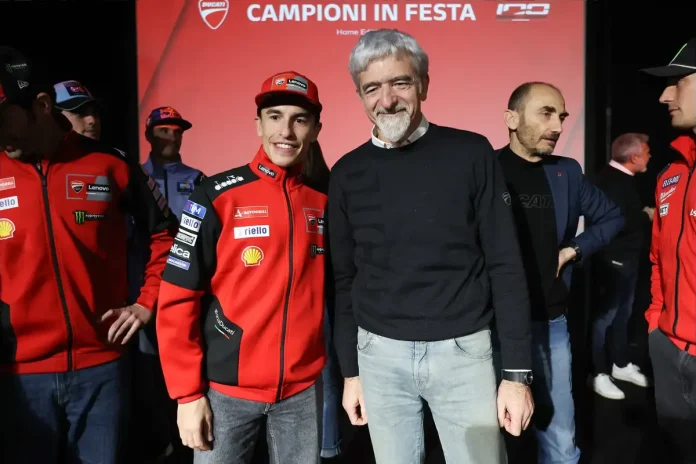
Marc Marquez has taken the MotoGP world by storm in 2025, dominating the championship with an almost unsettling authority. In his inaugural season with the prestigious Ducati team, the Spanish sensation clinched his seventh title in the premier class and his ninth world championship overall, leaving his competitors in the dust and rendering the title race virtually non-existent. Remarkably, he secured this crown with five races remaining, a testament to a season that was nothing short of a one-man show.
Expectations were high as Marquez transitioned to Borgo Panigale, but few could have anticipated such an unparalleled display of control. With a staggering eleven Grand Prix victories and fourteen sprint wins, his record includes an astonishing fifteen consecutive wins between Aragon and Catalunya. This season will undoubtedly be etched in history as one of the most dominant performances in modern MotoGP.
What sets Marquez apart, however, extends beyond mere statistics; it’s his mindset. Marco Rigamonti, Ducati’s technical director, highlights a crucial aspect of Marquez’s character: despite his superstar status, he has never demanded special treatment. Unlike some champions who adopt a diva-like attitude, Marquez remains grounded—engaging with his engineers and prioritizing his understanding of the motorcycle and performance management over celebrity status.
Perhaps the most shocking revelation of the season comes from Marquez himself, as shared by Rigamonti in an interview with Marca. The Italian technician disclosed, “this year, there were races where Marc Marquez did not attack at 100%.” This admission is almost surreal at this level of competition. Marquez wasn’t just winning by pushing the limits; he was doing so by exercising strategic control. He would push hard for a couple of laps to build a lead, then manage the pace to secure his victory.
Rigamonti notes, “At Misano, for example, he attacked fully throughout the race. He admits it himself.” This level of tactical racing is not accidental; it stems from years of pain, crashes, and recovery. Rigamonti emphasizes that if Marquez had been forced to constantly push to the limit, the consequences could have been dire. “If we put him in conditions where he has to always attack at full throttle, what would we be talking about? Maybe more crashes. We often forget that pushing hard means pushing your limits.”
In 2025, Marquez is no longer the reckless rider of his early days. He has an intimate understanding of the GP25 and, more importantly, of his own capabilities. This newfound wisdom has resulted in a dramatic reduction in crashes—just fourteen throughout the entire season, his lowest tally in four years.
However, this cautious approach has not completely eliminated risk. Marquez faced significant setbacks, including off-track excursions in Austin and Jerez, two dramatic crashes during testing in Assen, and a serious incident in Mandalika with Marco Bezzecchi that prematurely ended his season. This crash was particularly brutal, exacerbating an existing injury by twisting a screw in his right arm—a haunting reminder of his severe injury from 2020.
While 2025 will be remembered for its records, it will also stand out as the year Marc Marquez learned the art of restraint, mastering the balance between aggression and survival. He didn’t need to overexert himself to dominate the championship; he understood that sometimes, true brilliance lies not in speed but in the wisdom of when to hold back.