


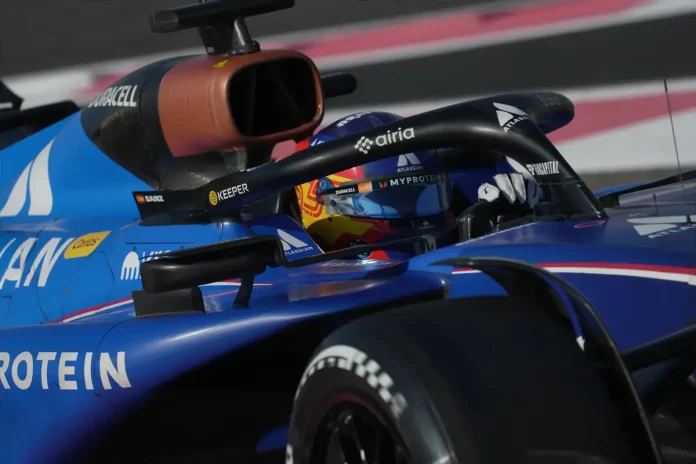
Carlos Sainz’s entry into Williams has been nothing short of a sensational transformation, marking a remarkable turn of events after his unexpected departure from Ferrari. As the Spanish driver took the wheel for his debut season with the historic team, he not only defied expectations but also outshined his former employer in a stunning display of resilience and skill.
During his stint at Ferrari, Sainz secured a modest four victories, often playing second fiddle to Charles Leclerc in their quest for the Constructors’ Championship. However, the move to Williams, a team with a storied legacy, provided Sainz the opportunity he craved: “I knew I was going to be listened to, welcomed, and that there was power to change things,” he asserted in an exclusive interview, emphasizing his desire for influence and improvement within the team.
The season kicked off with challenges, as Sainz struggled to find his footing in the slippery conditions of the Australian Grand Prix, resulting in a disheartening start with just one points finish in his first four races. Meanwhile, his teammate Alex Albon shone brightly, securing three points finishes and demonstrating a commanding performance that left Sainz playing catch-up. Yet, as the season progressed, the seasoned driver began to showcase his undeniable talent, gradually racking up lower half top-10 finishes and hinting at his potential to match Albon’s results.
Adapting to the Williams FW47, a car markedly less competitive than the Ferrari he had previously driven, proved to be a daunting task. Sainz candidly expressed his struggles, stating, “I don’t feel particularly at home with it… the car has some weaknesses that I cannot drive around.” His insights into the car’s limitations and the peculiarities of its performance underscored the challenges he faced, yet also highlighted his determination to unlock its potential.
A turning point arrived after the summer break; Sainz emerged reinvigorated and ready to seize opportunities. In a thrilling qualifying session in Baku, he secured a front-row start, a feat that hadn’t been achieved by Williams in over four years. This performance culminated in a historic podium finish at the Azerbaijan Grand Prix, marking the team’s first rostrum appearance since George Russell’s extraordinary drive in the 2021 Belgian Grand Prix. Sainz’s achievement placed him among an elite group of drivers, becoming only the second to podium with McLaren, Ferrari, and Williams, joining the ranks of four-time World Champion Alain Prost.
The momentum continued to build as Sainz delivered impressive performances in subsequent races, including top finishes in Singapore and a strong showing at COTA, where he finished seventh. His adaptability shone through in Qatar, where he capitalized on strategic opportunities to secure another podium, surpassing expectations and outpacing his former team Ferrari in the process. In an astonishing twist, Sainz outscored Albon 48-3 in the latter part of the season, further solidifying his role as a key asset for Williams.
As the 2025 season drew to a close, Sainz concluded just nine points behind Albon, a testament to his impact in revitalizing Williams’ fortunes. The team achieved its best Constructors’ Championship finish since 2017, a remarkable feat that underscores the significant role Sainz played in this turnaround. Notably, his track record of enhancing every team he has joined throughout his decade-long F1 career is evident, as he has consistently driven improvement in Toro Rosso, Renault, McLaren, Ferrari, and now Williams.
Looking ahead to the 2026 season, the partnership between Sainz and Williams holds tremendous promise. With the team shifting its focus to developing the next-generation car and Sainz gaining invaluable experience, the stage is set for a thrilling future. As Williams bids farewell to the 2025 season with renewed hope, Carlos Sainz stands at the forefront, ready to lead the charge into a new era for the iconic team in Formula 1.