


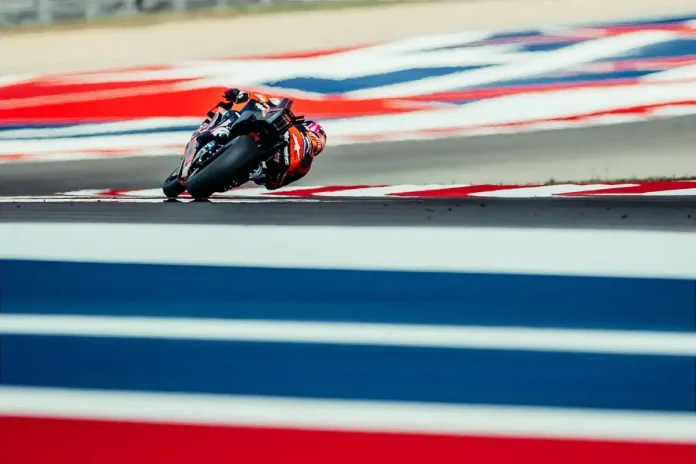
Enea Bastianini finds himself trapped in a high-stakes game of power and contracts that could shake up the MotoGP landscape. Despite a clear mutual agreement for him to return to Gresini Racing under the Ducati banner—a team where he blossomed with multiple wins and a title challenge in 2022—his future remains hostage to a hidden contractual clause favoring KTM. This clause, tucked away in his KTM contract, allows the Austrian manufacturer to unilaterally extend his deal for an additional year without his consent, effectively holding the key to his next career move.
Behind the scenes, Bastianini and Gresini have ironed out the details for him to replace Alex Marquez, a move that seems logical and almost inevitable given their shared history. Ducati's firm commitment to the Gresini team further cements the deal’s foundations, especially after considering other potential avenues like Honda. Yet all these positive signs are overshadowed by KTM’s looming decision, which could either unlock or block Bastianini’s switch. Until KTM makes its move, the Italian rider faces an agonizing stalemate where his ambitions and performances mean little compared to the cold mechanics of contract law.
This rare but perfectly legal contract clause places Bastianini in an unprecedentedly uncomfortable position. His career trajectory is no longer dictated by his own will or racing results but by a strategic call made in KTM’s boardrooms. The irony is brutal: his recent podium finish at the Austin sprint only increases KTM’s incentive to hold onto him. Instead of easing his exit, his success fuels KTM’s desire to activate their extension clause, turning his achievements into shackles rather than springboards.
The backdrop to this standoff intensifies the drama. Tech3’s uncertain future—potentially leaving KTM to align with Honda—could strip KTM of two valuable bikes, heightening the importance of every seat on their roster. The arrival of Alex Marquez and the presence of Maverick Viñales create a fierce internal competition, making every rider’s position a strategic chess piece. Retaining Bastianini, even against his wishes, could be KTM’s calculated move to preserve competitiveness and avoid vulnerability.
What’s at stake goes beyond one rider’s contract; it exposes a harsh truth in modern MotoGP where contracts morph into tools of control as potent as race results. Teams are locking down talent with clauses and conditions that leave riders like Bastianini caught in a bind—heroes on the track but pawns in management’s game. His predicament underlines the power imbalance where sporting merit can paradoxically limit personal freedom.
The potential pairing of Bastianini and Daniel Holgado at Gresini remains tantalizing but hinges entirely on KTM’s decision. Letting Bastianini leave would strengthen Ducati’s grip on the grid, while holding him tight secures KTM’s interests, albeit risking friction with a rider whose heart is elsewhere. This strategic tug-of-war will likely reach a climax around the French Grand Prix or Mugello, moments that could redefine the 2027 rider market.
If KTM relinquishes its grip, the announcement of Bastianini and Holgado teaming up at Gresini could be one of the most electrifying developments next season. But should KTM cling stubbornly to their contractual rights, Bastianini might face the grim prospect of riding for KTM against his will, a scenario that could dim his competitive fire and destabilize his career.
Enea Bastianini’s saga is a stark reminder that in MotoGP, raw talent alone no longer drives a rider’s destiny. Contracts have become cages, and success on the track can ironically chain a rider more tightly to his current team. The coming weeks promise a dramatic showdown between contractual power and personal ambition that could reshape the sport’s rider dynamics for years to come.