


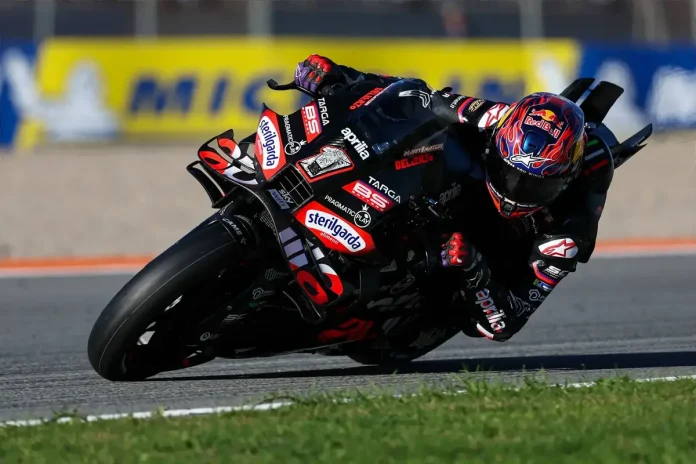
The 2025 MotoGP season was anticipated to be a triumphant return for Jorge Martin, a reigning world champion poised to defend his title with renewed vigor and a powerful new machine. Yet, what transpired was a harrowing saga marked by physical and mental turmoil. The recently released documentary, “Jorge Martín, from Paradise to Hell,” offers a raw and intimate look into this tumultuous year, narrated through the eyes of his partner, María Monfort, who witnessed the dramatic highs and devastating lows of Martin’s journey.
In February, the stars seemed to align for Martin. His adaptation to the new bike was seamless, and optimism surged. María recalls a Jorge full of life and enthusiasm: “He was very excited, very confident. He was having fun; all he wanted was to get back on the bike. He was overflowing with positive energy.” But the serenity was shattered at the Sepang circuit, where a catastrophic crash during official testing sent Martin crashing into a medical facility, leaving him with fractures in his right hand and left foot. This was just the beginning of a nightmare that would haunt him throughout the season.
“Jorge called me; he was already in the hospital. We talked, and he started crying, and I cried too… it was a whole drama,” María shared. Unbeknownst to them, this incident marked the turning point of the year. However, the first fall was merely a prelude to the chaos that would follow. The real devastation came from Martin’s own impatience, an obsession to return to racing too quickly. Determined to compete in Thailand, he pushed himself relentlessly, training on a supermoto until he crashed again, this time sustaining four more fractures on his left side.
“He spent two full weeks in recovery. He devoted all his energy to returning as fast as possible. The day before his flight, he went to train and crashed,” María explained. This encapsulates the agony of a racer whose mind was willing, but his body refused to cooperate.
Forced to watch the Grand Prix events in Thailand, Argentina, and the United States from his couch, Martin struggled with the emotional pain of his situation. “It was very hard. Psychologically, I think it was more difficult than the first. Not being able to do the pre-season preparation was already tough, but not being able to start the season was even worse.”
As if fate hadn’t dealt him a rough enough hand, April brought the moment that would redefine Martin’s year. The Losail circuit in Qatar, where he made his highly anticipated return, turned into a horror show. A crash on the 14th lap, followed by a devastating collision with Fabio Di Giannantonio’s bike, led to a diagnosis that sent shivers down everyone’s spine: a pneumothorax and eleven broken ribs. The race was no longer about competition; it was a battle for survival.
María vividly recalls the harrowing moment in the hospital: “I walked into the room, Jorge saw me and burst into tears. He kept repeating, ‘I don’t know what’s going to happen, but I love you, I love you, I love you,’ and I started crying too.” The fear was palpable, instinctive. “He was in tremendous pain, he wouldn’t stop crying. He was terrified. I thought that the first time I entered the room, Jorge was sure he was going to die.”
The weeks that followed were a silent hell: lung drainage, constant pain, and unbearable solitude, all compounded by existential doubt. “He was devastated. He doubted he would ever compete again.”
Finally, when he managed to return, misfortune struck again. During a sprint race in Motegi, another accident involving Marco Bezzecchi left him with a fractured collarbone, effectively ending his Asian season. The stark reality of a 21st-place finish was almost inconsequential in the grand scheme of things.
What truly mattered was the resilience to reach Valencia, to complete the season, to simply be there—standing, alive. As Martin crossed the finish line in Cheste, the results became irrelevant. He had fought through his darkest season. María encapsulates this moment beautifully: “The feeling Jorge had at the end of that race was, more or less, the same as when he became champion. He was reborn.”
MotoGP often glorifies the themes of bravery and legend, but is seldom reminded of vulnerability. This documentary serves as a poignant reminder that behind the helmets and titles, there are real human beings facing extraordinary challenges. Sometimes, just finishing a season can be as significant as winning a world championship.