


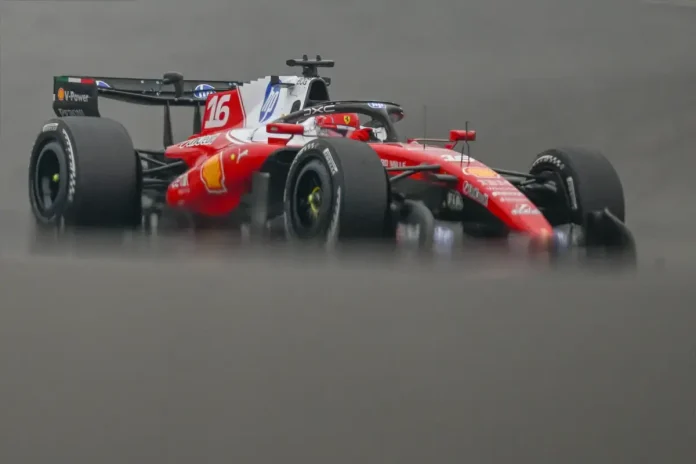
In a striking revelation that could shake the foundations of Formula 1, Charles Leclerc has candidly admitted that the thrill of taking risks on qualifying laps has become a thing of the past. Once hailed as one of the grid’s most formidable qualifiers, with a staggering 27 pole positions to his name, Leclerc now finds himself grappling with the limitations imposed by the newly introduced 2026 cars. This evolution in technology has transformed the very essence of qualifying, leaving Leclerc to confront a daunting reality: his trademark audacity is no longer a viable strategy.
Leclerc, known for his exhilarating performances that often saw him push the limits of his car, is now navigating a landscape where the stakes have shifted dramatically. “It’s a lot down to understanding these new cars,” he revealed to reporters, emphasizing the challenges that come with adapting to the latest machinery. The thrill of chasing down pole positions through sheer bravado has been replaced with a cautious approach that prioritizes consistency over risk-taking.
The young driver articulated his frustration with the new dynamics, stating, “They are very strange in qualifying, because in the past one of my strengths coming into Q3, I was just taking massive risks to get something out more.” This admission lays bare the stark transformation within the sport, where drivers can no longer rely solely on their instinct and aggression to secure prime starting positions. Instead, they must now contend with the complexities of engine management and car handling that complicate the pursuit of speed.
In the early rounds of the season, Leclerc managed to secure fourth place on the grid, a reflection of his adaptability in the face of these new challenges. Yet, he lamented the loss of the exhilarating moments that defined his previous qualifying sessions. “Consistency pays off more,” he noted, shedding light on the strategic recalibration required in the current competitive environment. The thrill of a daring lap has been replaced with a more methodical approach, as drivers seek to find their rhythm across multiple qualifying sessions rather than pushing for that one spectacular run.
As Leclerc reflected on his experience in China, he acknowledged the bittersweet nature of his performance: “I felt like I just found my rhythm from Q1 to Q3, which is a bit less exciting for Q3 when you are in the car, because you can’t push like you want.” While this new strategy has yielded results, bringing him closer to his rivals, it comes at the cost of the dynamic flair that once made qualifying an exhilarating spectacle.
In a sport that thrives on speed and daring, Leclerc’s admission serves as a potent reminder of how rapidly the landscape of Formula 1 can shift. As drivers adapt to the relentless evolution of technology, the essence of what it means to compete at the highest level is being redefined. The thrill of risk may be waning, but the pursuit of excellence remains at the heart of this breathtaking sport.