


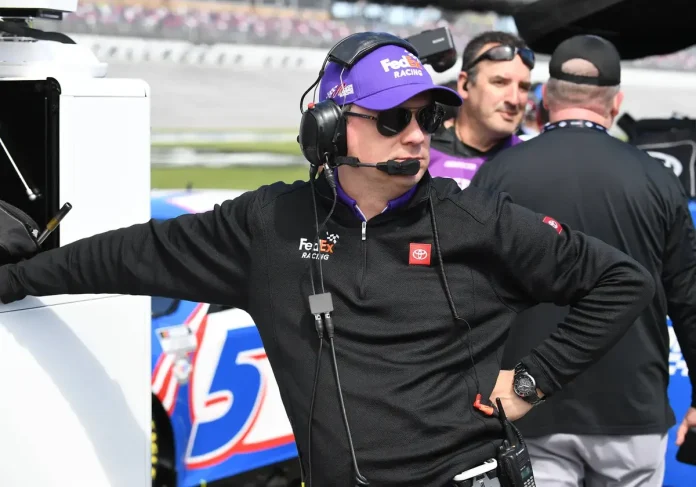
In a dramatic turn of events, the legal battle between Joe Gibbs Racing (JGR) and Chris Gabehart has taken center stage, with a federal judge stepping in to impose a restraining order that shakes the foundations of the NASCAR community. On March 2, 2026, Judge Susan C. Rodriguez delivered a ruling that allows Gabehart to continue his career with Spire Motorsports, albeit under strict conditions that could redefine the competitive landscape of the sport.
The judge’s order, initially conveyed verbally, was later formalized in writing just before the crucial Phoenix race. Significantly, Gabehart has been granted permission to assume the role of Chief Motorsports Officer at Spire Motorsports, a position that starkly contrasts with his former duties as JGR’s competition director. This separation of roles is pivotal, as it aims to prevent any overlap between his past responsibilities at JGR and his new position, thereby attempting to mitigate concerns over potential intellectual property theft.
However, the implications of this ruling extend far beyond Gabehart’s employment status. Judge Rodriguez has mandated that he must return any proprietary information or trade secrets he may have acquired during his tenure at JGR. NASCAR analyst Matt Weaver succinctly summarized the situation on social media, noting the judge’s decision to formalize the temporary restraining order against Gabehart and Spire Motorsports.
As the clock ticks toward the expiration of the restraining order on March 16, 2026, the court will reconvene to decide whether to impose a longer injunction or allow for expedited discovery into Gabehart’s electronic devices. Meanwhile, Joe Gibbs Racing is pursuing a staggering $8 million in damages, alleging that Gabehart illicitly copied sensitive data—including drivers’ salaries and team revenue figures—to benefit his new employer.
In a bold response to the legal accusations, Gabehart has publicly refuted claims of wrongdoing. Ahead of the February 26 hearing, he released a declaration asserting that he did not steal or misuse any confidential information. He characterized the lawsuit as a punitive measure against him for leaving JGR, stating, “This lawsuit is not about protecting trade secrets—it is about punishing a former employee for daring to leave.”
Gabehart further expressed his frustrations with the organizational dynamics at JGR, revealing that team owner Joe Gibbs exerted substantial pressure on him to take on the role of crew chief for his grandson, Ty Gibbs, during the 2025 season. He described the experience as a “dysfunctional organizational structure” that he could no longer tolerate.
Having joined the Cup Series in 2012 as an engineer, Gabehart’s ascent within JGR was marked by a series of commendable successes, including multiple victories alongside driver Denny Hamlin. His promotion to competition director in the 2025 season seemed to herald a bright future, but the current legal turmoil has drastically altered the trajectory of his career.
As this high-stakes legal drama unfolds, the implications for both Gabehart and Joe Gibbs Racing are profound. The outcome of this lawsuit could reshape the competitive hierarchy within NASCAR, setting a precedent for how teams manage personnel transitions and protect their proprietary information in an increasingly cutthroat environment. With emotions running high and the stakes even higher, all eyes will be on the courtroom as the saga continues to develop.