


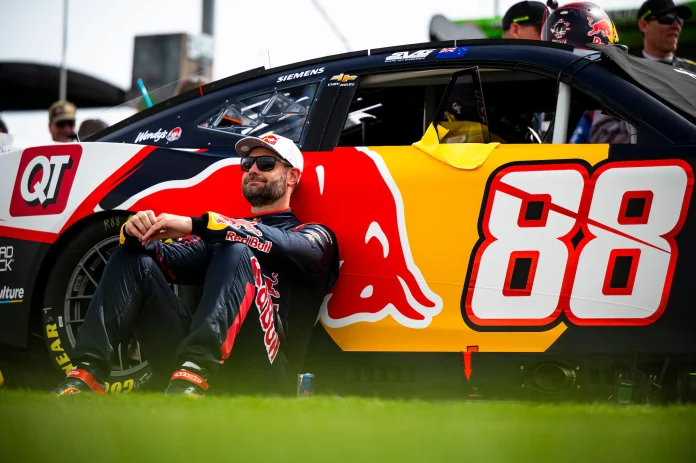
Supercars racing is a formidable challenge, and few understand this better than Shane Van Gisbergen, a three-time champion who has dedicated his career to mastering this grueling sport. Recently, he found himself in a unique position, no longer the sole outsider when NASCAR’s Austin Cindric made his debut in the Repco Supercars championship. Despite finishing in last place at the prestigious BP Adelaide grand final, Van Gisbergen was full of praise for Cindric’s daring venture. Speaking candidly, he remarked, “Well, he was last. Like our guys are so good over there.” This bold statement underscores the intense competition within the Supercars realm, where even the least experienced drivers possess remarkable skills honed in various junior categories.
Cindric’s transition into this high-octane series was nothing short of spectacular. The 27-year-old NASCAR regular, famously victorious at the Daytona 500, took the plunge into the Australian racing scene, showcasing his talents in a Tickford Racing-prepared Ford Mustang. This leap into the world of Supercars is monumental, especially considering the series’ reputation for fierce competition and challenging street circuits.
However, racing on these circuits introduces a steep learning curve. Van Gisbergen acknowledged this when he said, “The conditions looked pretty difficult on Saturday, and yeah, he did a solid job.” It’s clear that for a driver trained on left turns, adapting to the right-hand corners of street racing requires significant adjustment. SVG’s respect for Cindric’s effort highlights the reality that transitioning between racing disciplines is no easy feat; he noted, “If you put any of the Supercars drivers into an oval, they’d be at the back as well. They’re two completely different disciplines.”
Cindric’s foray into Supercars was not merely a publicity stunt; it was a well-prepared endeavor aimed at bridging the gap between NASCAR and the Australian racing community. Prior to his debut, he engaged in extensive ride days and test sessions to familiarize himself with the Gen3 Mustang and the nuances of street circuit racing. Supercars CEO James Warburton praised this crossover, emphasizing its potential to captivate audiences from both series.
As Cindric navigated the complexities of Supercars, Van Gisbergen reflected on his own journey in NASCAR. The Kiwi driver, who has become a dominant force on road courses, has faced his own trials on oval tracks. His 2025 season was a rollercoaster, defined by initial struggles in oval races, which left him frequently outside the top 20. However, the narrative changed dramatically as SVG began to adapt to the demands of oval racing. By September, he celebrated a significant milestone with his first top 10 finish at Kansas Speedway, a testament to his perseverance.
In discussing his challenges, Van Gisbergen revealed, “I didn’t do a good enough job, and that’s the pressure of the playoffs.” The pressure intensified during the playoffs, but once eliminated from championship contention, his team seized the opportunity to experiment with their car setups. This strategic move proved fruitful; he quickly began to see improvements, qualifying strongly and maintaining a competitive presence in subsequent races.
Heading into 2026, Van Gisbergen is armed with newfound confidence and momentum, signaling to his competitors that he is not just a road course contender but a formidable force on ovals as well. The evolution of both athletes, one from NASCAR to Supercars and the other adapting to oval racing, exemplifies the dynamic nature of motorsport, where skill, adaptability, and the courage to embrace new challenges define the champions of tomorrow.